
A membrane upgrade that could delete an entire pre - treatment stage.
In brief
New polyester - based membrane formulations resist chlorine - induced degradation entirely, removing the need for the extensive dechlorination pre - treatment that conventional polyamide RO membranes require - a meaningful simplification for plant design and operating cost.
Standard polyamide RO membranes have a well-known weakness: chlorine attacks them. That's why almost every RO plant runs a dechlorination stage before water ever touches the membrane, then re-chlorinates afterward for disinfection - an extra process step that exists purely to protect the membrane material itself.
The chemistry behind the fix
Research published in Nature Sustainability describes a polyester thin - film composite membrane built via layer - by - layer interfacial polymerization of 3,5 - dihydroxybenzoic acid with trimesoyl chloride. The resulting poly(isophthalester) structure uses steric hindrance and an electron - withdrawing group to physically block chlorine from reacting with the aromatic ring - the mechanism that degrades conventional polyamide membranes over time.
Why this changes plant economics, not just chemistry
The performance numbers matter, but the bigger deal is what the membrane makes unnecessary. Eliminate the chlorine sensitivity and you can eliminate the dechlorination/rechlorination cycle entirely - a real reduction in both capital equipment and ongoing operating cost. Dechlorination upstream of RO doesn't just add cost; it also strips out the disinfection chlorine was providing in the first place, which then has to be reintroduced downstream. A membrane that simply tolerates chlorine sidesteps that whole trade - off, and tends to need fewer cleaning cycles as a side benefit.
What makes this a genuine plant-design change rather than just a membrane upgrade is the process step it deletes entirely: dechlorinate, treat, then re-chlorinate for disinfection becomes just treat, with the membrane itself tolerating what used to be its biggest vulnerability. Whether chlorine-resistant polyester membranes reach commercial mainstream pricing fast enough to make retrofitting existing RO trains worthwhile is the open question for plants currently budgeting a dechlorination stage.
Why it matters
For any RO plant currently budgeting for dechlorination stages, this is a technology shift worth tracking as chlorine - resistant membranes become commercially mainstream.
Sources
StartUs InsightsRead original ↗Nature Sustainability (chlorine - resistant polyester RO membrane research)↗Found an error? See the Corrections Policy.
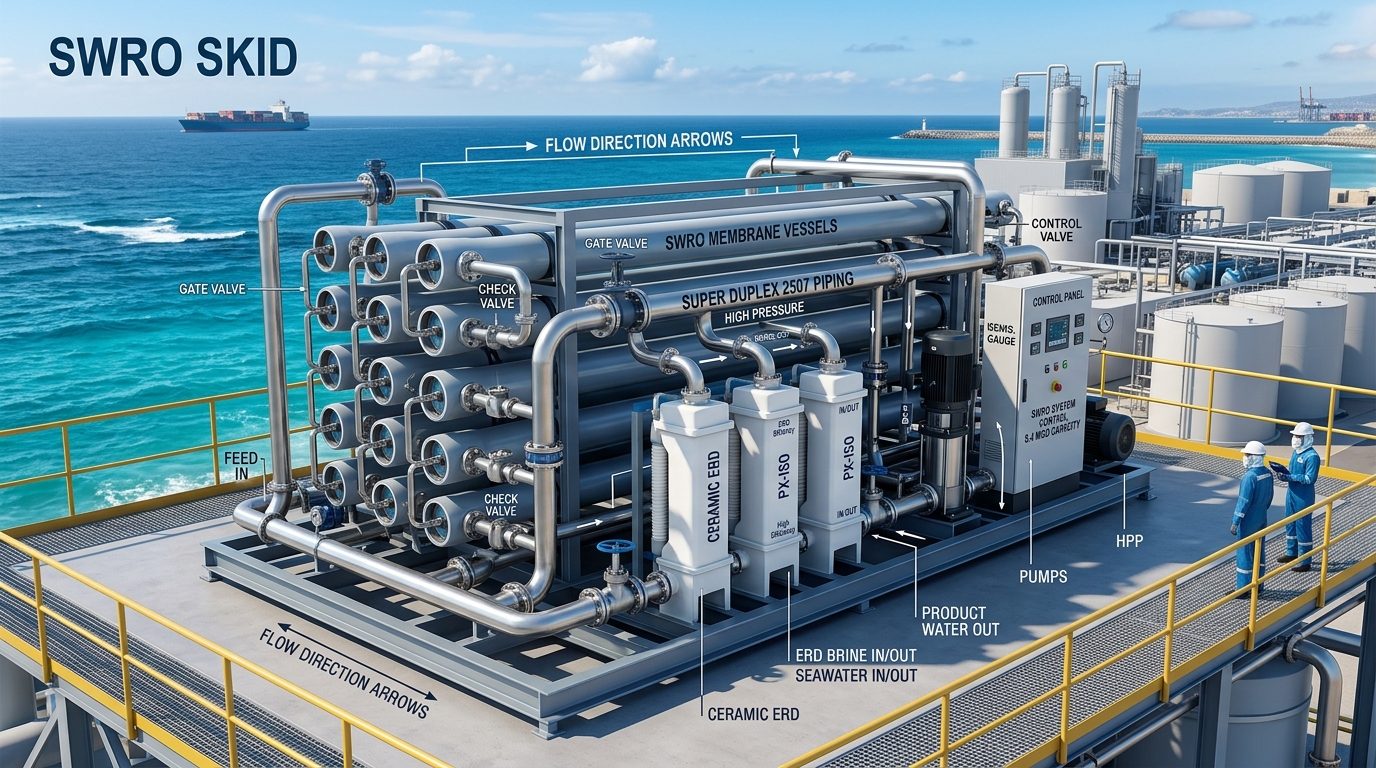
Image: Seawater Reverse Osmosis (SWRO) Membrane Vessels & Isobaric Energy Recovery