
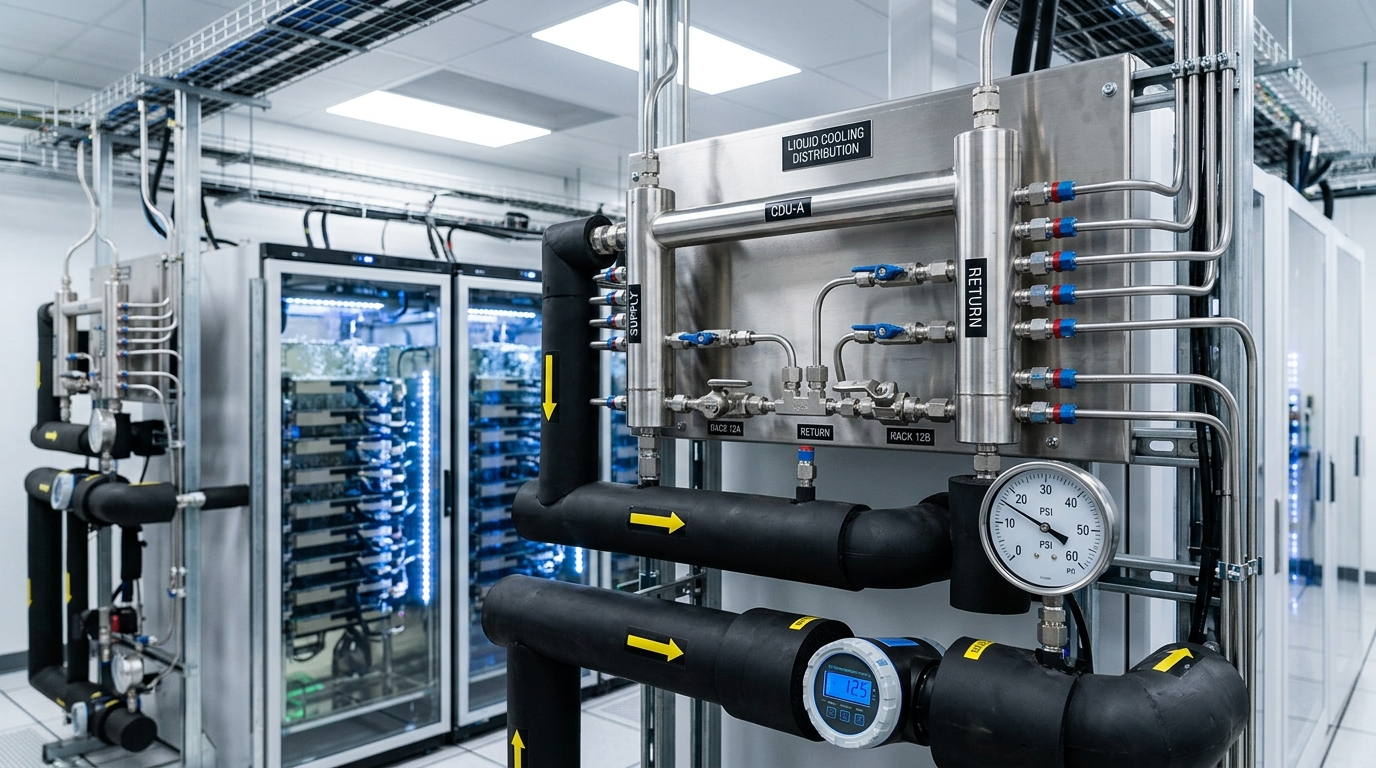
AI cluster infrastructure transitions away from evaporative cooling towers, slashing facility water consumption by millions of liters daily in water-stressed tech corridors.
In brief
On October 9, 2026, leading global cloud hyperscalers operating mission-critical AI compute hubs in Mumbai, Hyderabad, and Phoenix confirmed full-scale transitions toward closed-loop direct-to-chip and immersion liquid cooling. The shift completely replaces traditional open-loop evaporative cooling towers, eliminating daily water consumption rates that previously exceeded 1.5 million liters per facility.
The meteoric rise of high-density artificial intelligence training clusters has triggered an unintended environmental crisis: astronomical municipal water consumption. Traditional data center cooling relies heavily on cooling towers that evaporate millions of liters of potable water daily to dissipate rack heat loads.
The Evaporative Water Trap in Urban Megacities
A standard 100-megawatt data center campus utilizing evaporative chillers typically consumes between 1.2 and 2.5 million liters of fresh water every day—equivalent to the domestic consumption of a town of 15,000 residents. In cities like Hyderabad, Bengaluru, and Mumbai, public backlash and municipal allocation caps have made further facility water permits impossible to secure.
By replacing evaporative wet towers with closed-loop dielectric immersion tanks and direct-to-chip microfluidic cold plates, heat is transferred directly to synthetic hydrocarbon or fluorochemical fluids. The fluids circulate in hermetically sealed systems through dry fin-fan heat exchangers that rely entirely on ambient airflow.
Near-Zero Water Usage Effectiveness (WUE)
Audited metrics demonstrate that facilities retrofitted with closed-loop liquid architectures achieve a Water Usage Effectiveness (WUE) of less than 0.02 liters per kilowatt-hour, compared to 1.8 L/kWh in older wet-cooling installations. Furthermore, capturing high-temperature waste heat (55°C–65°C) from the liquid loop allows data centers to supply district heating networks or tertiary water distillation systems.
Hyperscale operators signing 2026 lease renewals in drought-sensitive corridors are now contractually required to maintain a zero-evaporative potable water guarantee during peak summer grid alerts.
The technological transition proves that computing growth and municipal water security can co-exist when modern thermodynamic engineering replaces open evaporative waste.
Why it matters
Decouples the rapid expansion of artificial intelligence data processing from municipal drinking water reserves in arid and semi-arid urban regions.
Sources
Global Data Center Sustainability Consortium & Enterprise Engineering Brief (October 9, 2026)Read original ↗Uptime Institute Data Center Water Usage Effectiveness (WUE) Benchmarks↗Rispri Labs Industrial Cooling Water Management & Energy Efficiency↗Found an error? See the Corrections Policy.
Image: Enterprise Data Center Closed-Loop Liquid Cooling Distribution Infrastructure