
Understanding the functional, chemical, and regulatory differences between treatment plant types.
In brief
Confused between ETP, STP, and ZLD mandates? Here is a complete breakdown of when an Effluent Treatment Plant is required vs a Sewage Treatment Plant, and how Zero Liquid Discharge integrates membrane RO and thermal evaporation to achieve 100% water recovery.
Three letters - ETP, STP, ZLD - show up on every CTE and CTO document a plant manager signs, and it's genuinely common to hear them used almost interchangeably in casual conversation, right up until a facility gets penalised for mixing domestic sewage with industrial effluent and assuming one treatment system could handle both.
1. STP (Sewage Treatment Plant)
An STP is designed exclusively for domestic wastewater (black water from toilets, grey water from canteens and handwashing). The contaminants are organic matter, pathogen indicators (E. coli), nitrogen, and phosphorus. STPs rely almost entirely on biological digestion (MBBR, SBR, or MBR) followed by chlorination or UV disinfection. Treated STP water is typically reused for flush tanks, landscaping, or cooling tower makeup.
2. ETP (Effluent Treatment Plant)
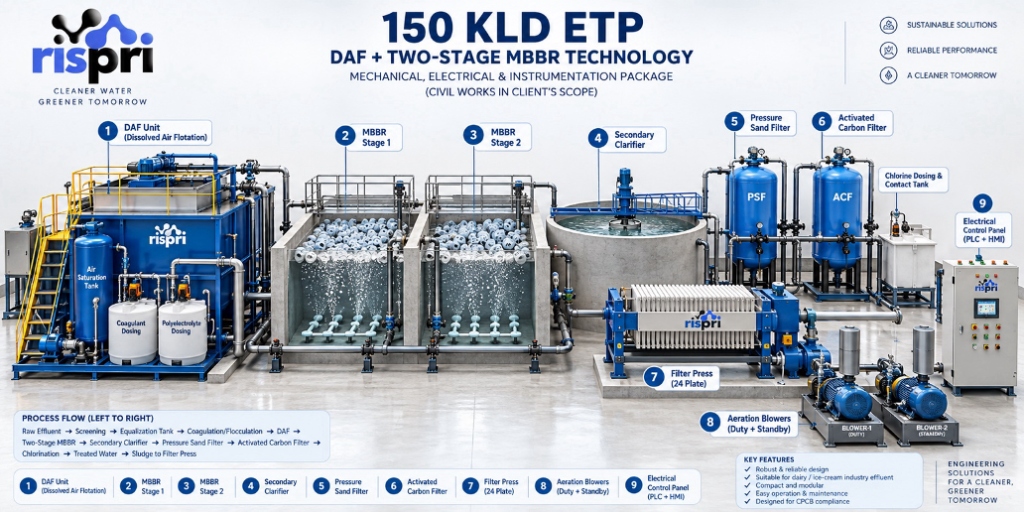
An ETP treats industrial process wastewater - containing heavy metals, oils, emulsified greases, synthetic dyes, acids, alkalis, and toxic solvents. Because chemical composition varies wildly between a textile mill and a galvanising unit, ETPs use physical - chemical treatment (equalisation, flash mixing, coagulation, flocculation, primary settling) followed by biological oxidation and tertiary filtration. Discharge must meet industry - specific CPCB limits before release into river bodies or CETPs.
3. ZLD (Zero Liquid Discharge)
ZLD is not a single treatment vessel - it is a complete process flow philosophy. A ZLD system takes the treated liquid stream from an ETP or STP and subjects it to multi - stage High - Recovery Reverse Osmosis (HRRO), achieving up to 90 - 95% clean water recovery for plant reuse. The remaining 5 - 10% concentrated brine is routed to a Thermal Evaporator (Multi - Effect Evaporator / MEE or Mechanical Vapor Recompression / MVR) and Crystalliser, reducing the final waste to dry solid salts for safe landfilling.
The distinction isn't academic - picking the wrong architecture for a site's actual waste stream is one of the more expensive mistakes a plant can make at the design stage, because retrofitting a biological-only STP to handle heavy metals or solvents later is far costlier than specifying the right plant type from day one.
Why it matters
Industrial facilities often get penalized for mixing domestic sewage with industrial process effluent or assuming an STP can handle chemical waste. Selecting the right plant architecture protects capital investment and ensures SPCB CTO compliance.
Found an error? See the Corrections Policy.
Image: Industrial Effluent Treatment Plant (ETP) Process Flow & DAF/MBBR Clarifier