
The national average looks manageable. It isn't, once you look at which 281 districts are pulling the number down.
In brief
The Dynamic Ground Water Resources Assessment for 2025, presented in Parliament in August 2026, puts India's annual groundwater extraction at 247 BCM against a replenishable resource of 408 BCM - a national extraction stage of 60.63%. But 281 districts across nine states including Punjab, Haryana, Rajasthan, Delhi, UP and Tamil Nadu already exceed the national average, and those are the districts where industry, agriculture and municipal demand compete most fiercely.
A national number can hide a regional crisis, and India's groundwater data is a textbook case. The headline figure - 60.63% of replenishable groundwater already extracted - sounds manageable on its own. It isn't, once you see which 281 districts are dragging the average up.
Why the national average misleads
The 60% national figure masks a distribution problem. Extraction is not spread evenly across India's aquifers - it is concentrated in 281 districts across nine states and union territories: Punjab, Rajasthan, Haryana, Delhi, Puducherry, Tamil Nadu, Uttar Pradesh, Chandigarh and Karnataka. In these districts, extraction already exceeds what recharge can replenish annually, and falling water tables are not a projection - they are a documented, ongoing trend.
What the Annual Ground Water Quality Report adds
The companion Annual Ground Water Quality Report for 2025 confirms that while groundwater is broadly potable across much of India, localised contamination from salinity, fluoride, nitrate and arsenic persists across multiple districts. For industrial water users, this means the starting quality of available groundwater is not uniform - and facilities treating process water or drinking water from stressed wells are dealing with a feed that shifts over time as over - exploitation changes aquifer chemistry.
The regulatory consequence
CGWA's existing rules already restrict new major NOCs in 'over - exploited' assessment blocks - the category that covers most of those 281 districts. As the assessment data updates annually and new blocks tip into over - exploited status, facilities operating on older NOCs in those areas should expect renewal to involve scrutiny that wasn't there five years ago.
For facilities in those 281 districts, the compliance trajectory is fairly predictable: CGWA already restricts new major NOCs in over-exploited blocks, and as more blocks tip into that category each year, renewal on an older NOC in one of these areas is likely to draw more scrutiny than it would have five years ago.
Why it matters
The national headline figure understates regional stress. Industrial operations in the 281 over - stressed districts are the most exposed to CGWA NOC restrictions, telemetry mandates, and eventual groundwater allocation competition - all of which reward facilities that have already built water recycling and ZLD systems.
Sources
PIB / Ministry of Jal Shakti (Parliament, August 2026)Read original ↗New Indian Express - parliamentary data coverage↗CGWA - groundwater assessment methodology↗Found an error? See the Corrections Policy.
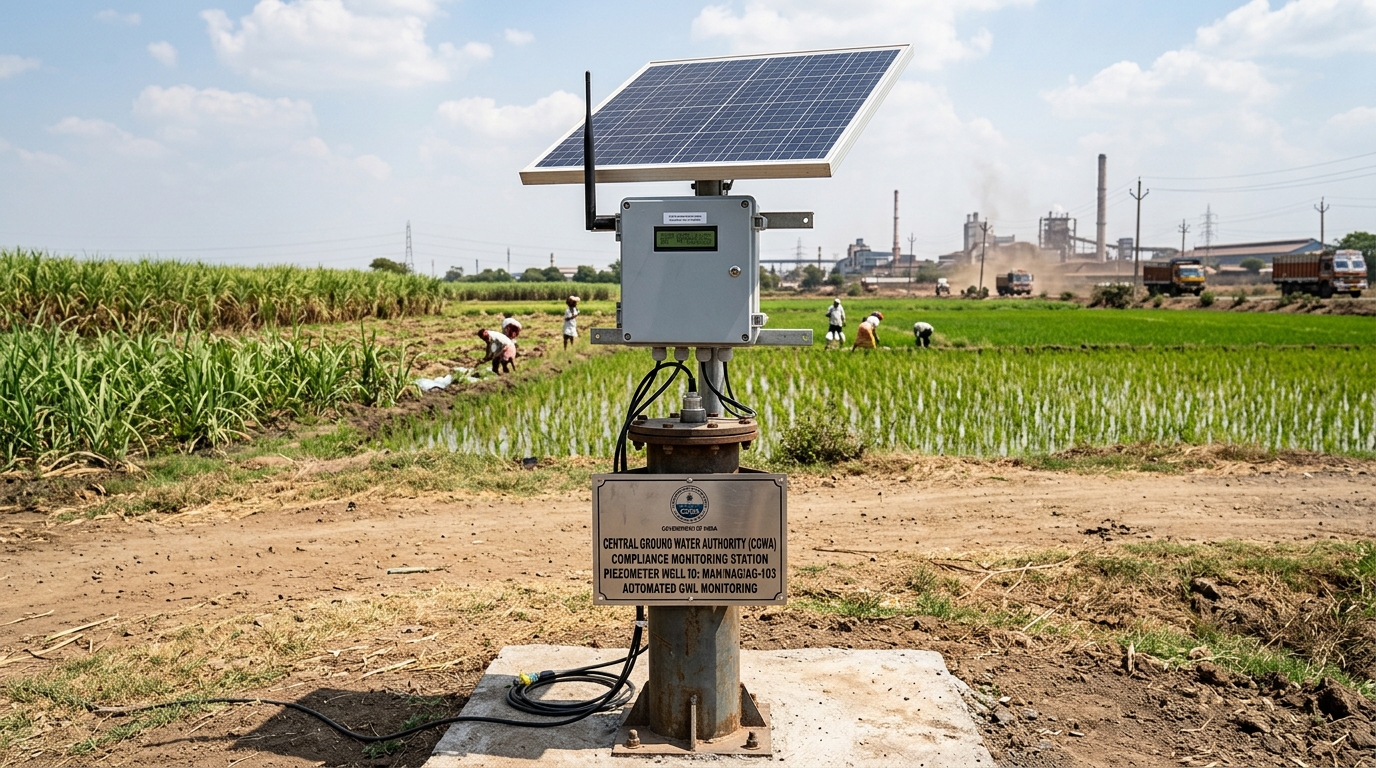
Image: Automated Digital Piezometer & Real-Time IoT Groundwater Monitoring Station