
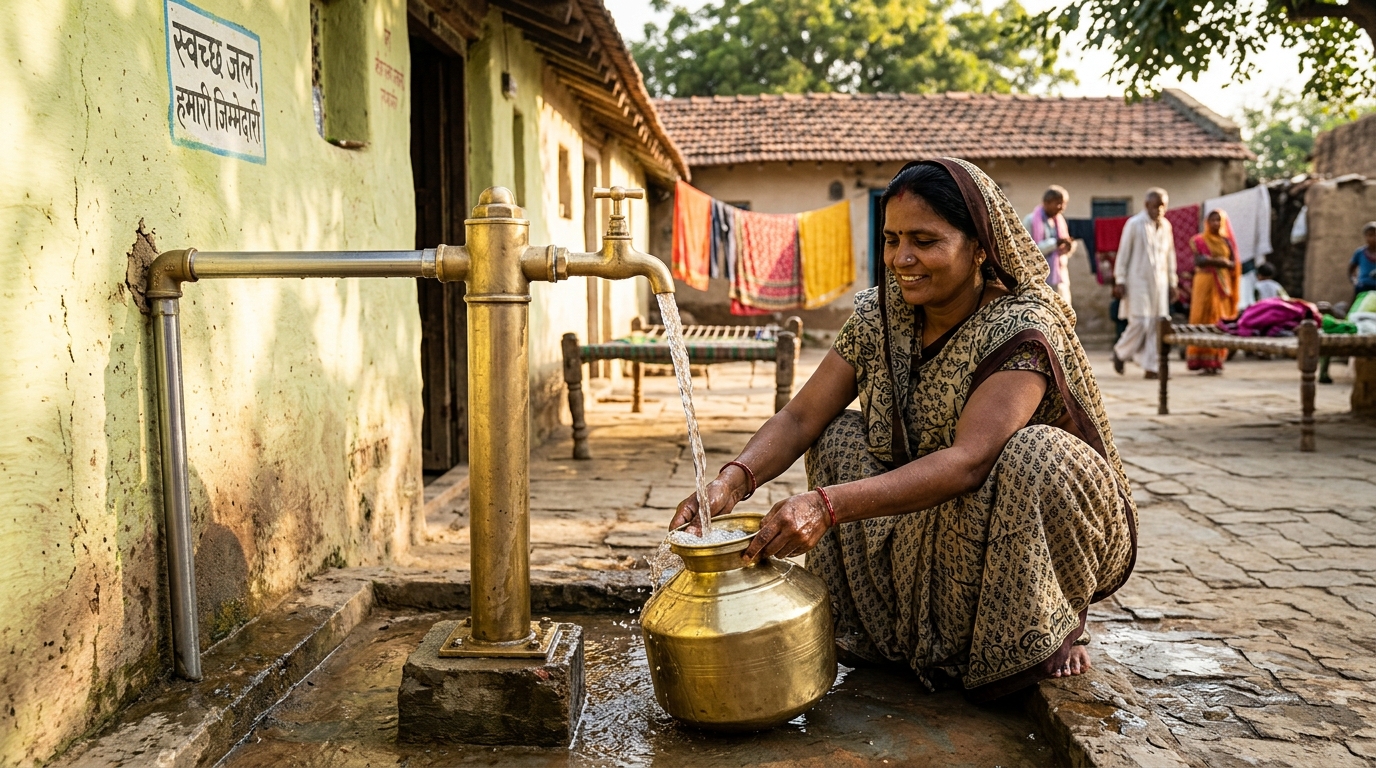
82% of rural households now have tap connections. The new mission is about making sure the water actually flows.
In brief
The Union Cabinet approved Jal Jeevan Mission 2.0 on 10 March 2026 with a total outlay of ₹8.69 lakh crore, extended to December 2028. With tap connections already reaching over 82% of rural households, the mission's strategic focus has shifted from construction to service delivery, operation & maintenance, water quality surveillance, and community - led governance through Village Water and Sanitation Committees.
Building 82% of rural India a tap connection was the easier part, relatively speaking. Jal Jeevan Mission 2.0 - approved by the Union Cabinet on 10 March 2026 with an outlay of ₹8.69 lakh crore - exists because connecting a pipe to a house and keeping water flowing through it reliably turned out to be two very different problems.
What changed between JJM 1 and JJM 2
The first mission was primarily a construction programme - building the last - mile pipe infrastructure to reach rural homes. The data showed it worked in terms of coverage numbers. What it also revealed is that physical connection does not equal reliable supply: infrastructure installed without adequate operation and maintenance plans degrades quickly in rural settings with limited technical capacity. JJM 2.0 explicitly addresses this by making service delivery, not connection count, the primary metric. Village Water and Sanitation Committees (VWSCs) and Gram Panchayats are being empowered to manage systems locally, with reform - linked MoUs between the Centre and states to formalise accountability.
Water quality as the new challenge
A significant portion of JJM 2.0 focus falls on water quality surveillance - particularly for fluoride, arsenic, nitrate and iron contamination in groundwater - dependent rural supplies. The mission runs parallel to the Jal Sanchay Jan Bhagidari initiative (launched 2024, scaling in 2026), which links rainwater harvesting and recharge mandates to a people's movement model at village level. The SNA - Sparsh digital platform provides real - time fund tracking and accountability across state - level programme implementation.
The market implication for water treatment
JJM 2.0 creates a genuine demand signal for small - scale water treatment solutions at gram panchayat level - chlorination systems, iron and fluoride removal units, community RO plants, and chemical dosing for disinfection. The delivery model is local institutions rather than state procurement, which opens the market to suppliers who can serve Tier 3 and Tier 4 geographies with technical support, not just product.
For water treatment providers, the interesting shift is who's buying: JJM 2.0's delivery model runs through Gram Panchayats and local Village Water and Sanitation Committees rather than centralised state procurement, which opens a genuine market in Tier 3 and Tier 4 geographies for anyone who can offer technical support alongside the hardware, not just sell the equipment and leave.
Why it matters
The original JJM built the pipes. JJM 2.0 now has to make them functional and sustainable - which means a surge in demand for water quality testing, small - scale treatment systems, chemical dosing, and O&M capability at gram panchayat level. For water treatment providers, this is a new customer segment at scale.
Sources
PIB / Ministry of Jal ShaktiRead original ↗Jal Jeevan Mission official portal↗PIB - August 6 fund release: ₹6,154 crore to states↗Found an error? See the Corrections Policy.
Image: Piped Rural Drinking Water Infrastructure & Community Tap Standpost