
Zero Liquid Discharge (ZLD) installations in Tirupur, Surat, and Dhaka replace high-pressure steam boilers with electrical centrifugal vapor compressors to crystallize high-TDS dyeing salts.
In brief
Textile dyeing industrial clusters across Tirupur, Surat, and Dhaka released comparative operational benchmarks on October 14, 2026, demonstrating that retrofitting thermal Zero Liquid Discharge (ZLD) plants with Mechanical Vapor Recompression (MVR) evaporators reduces steam and energy costs by 42%. The closed-loop compression cycles produce reusable sodium sulfate salt and recover 96% pure process condensate.
Textile wet-processing facilities discharge large volumes of high-salinity dye bath effluent loaded with sodium chloride, sodium sulfate, and hydrolyzed reactive dyes. While environmental regulations in major Asian textile centers mandate Zero Liquid Discharge, the massive coal and biomass steam costs required by multi-effect evaporators (MEE) have strained mill profitability.
Latent Heat Recycling via Centrifugal Vapor Compression
Mechanical Vapor Recompression (MVR) operates by recycling the latent heat of evaporation. Secondary steam generated in a falling-film evaporator is compressed by a high-efficiency centrifugal blower, raising its saturation temperature and pressure. The compressed vapor is then reintroduced directly into the evaporator's heating calandria, condensing and transferring its latent heat back to the boiling brine.
The operational data reveals that MVR requires only 28 to 35 kWh of electrical energy per ton of evaporated water, entirely eliminating continuous boiler live-steam consumption during steady-state operations. Clean condensate with conductivity below 25 µS/cm is returned directly to textile dyeing machines.
Fractional crystallization stages coupled with MVR yield recovered sodium sulfate with over 98.5% chemical purity, which mills reuse in subsequent reactive dyeing baths, replacing virgin commercial salt purchases.
Common Effluent Treatment Plants (CETPs) in Tirupur and Surat are aggressively phasing out legacy multi-effect evaporators in favor of skid-mounted MVR units.
Why it matters
Thermal evaporation steam expenses have historically made textile ZLD operations economically punishing; MVR cuts operational energy expenses in half while promoting circular salt recovery.
Sources
Textile Processing & Industrial Sustainability Journal (October 14, 2026)Read original ↗Textile Sustainability and ZLD Technology Coalition↗Rispri Labs Industrial Textile ZLD Engineering Consultation↗Found an error? See the Corrections Policy.
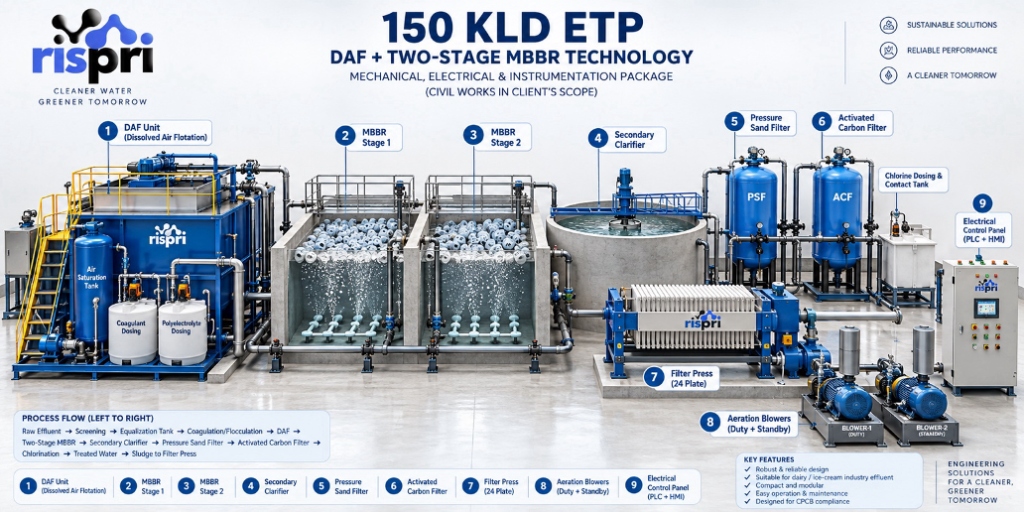
Image: Industrial Effluent Treatment Plant (ETP) Process Flow & DAF/MBBR Clarifier