
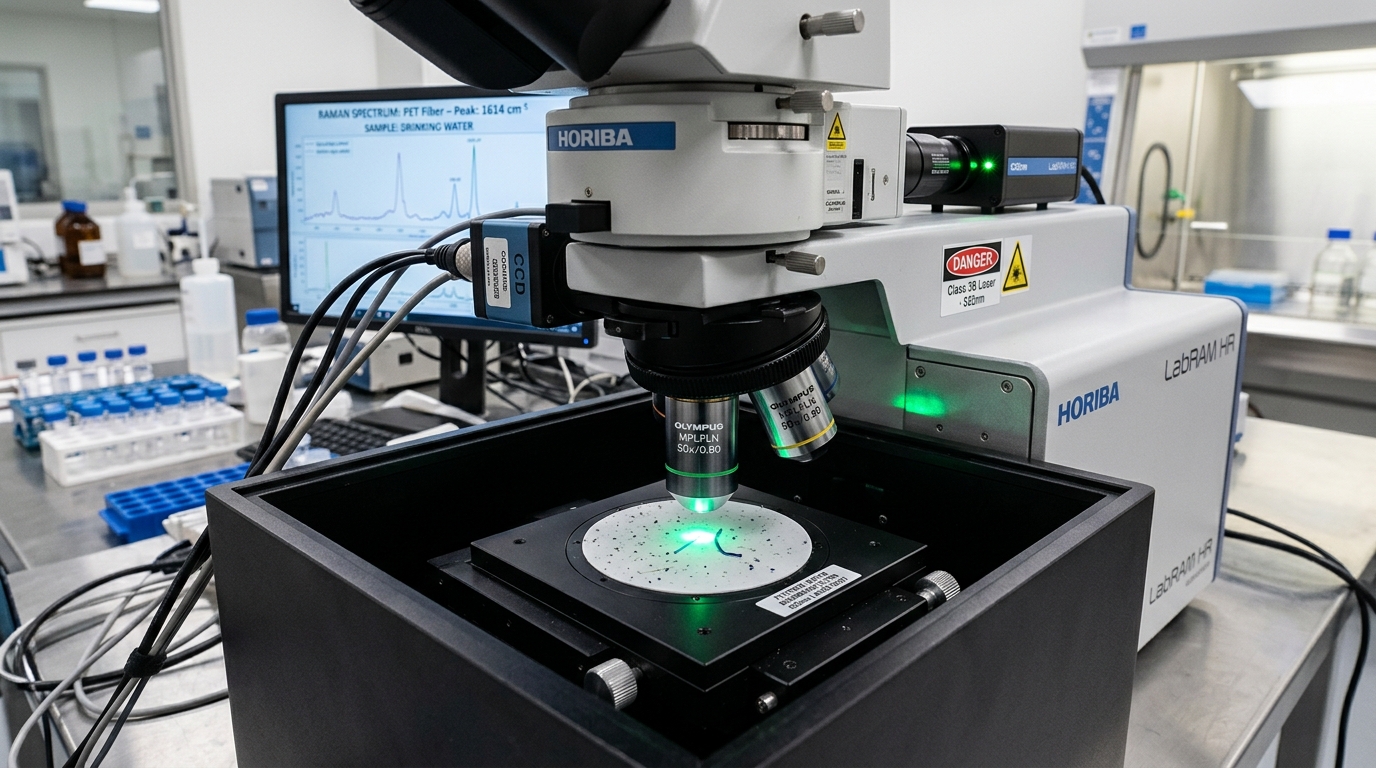
Public water utilities serving over 100,000 residents must systematically quantify polymer fragments down to 1 micrometer in treated supplies, establishing global analytical precedent.
In brief
On October 3, 2026, the California State Water Resources Control Board officially adopted mandatory standardized testing and reporting requirements for microplastics in public drinking water supplies. Under Phase 2 of the landmark mandate, major public water utilities serving over 100,000 residents must deploy laser direct infrared (LDIR) and Raman spectroscopy to measure, size-classify, and chemical-fingerprint microplastic particles between 1 micrometer and 5 millimeters in drinking water networks.
Microplastics have permeated every corner of the global biosphere—from ocean trenches to mountain glaciers. Yet despite widespread public concern, environmental health regulators historically hesitated to mandate testing in municipal drinking water due to a lack of standardized analytical methodologies.
The Breakthrough in Analytical Metrology
California has broken this regulatory inertia by promulgating the world's first formal standard operating procedure (SOP) for microplastics quantification. The methodology requires utilities to filter large water samples (1,000 liters) through stacked stainless steel sieves, digest natural organic debris with enzymatic hydrogen peroxide, and analyze particle residues using automated Laser Direct Infrared (LDIR) imaging and micro-Raman spectroscopy.
The standardized protocol requires laboratories to classify particles into four distinct size bins (1–20 µm, 20–100 µm, 100–500 µm, and 500 µm–5 mm) and report polymer identification spectra, distinguishing polyethylene (PE), polypropylene (PP), polyethylene terephthalate (PET), and polystyrene (PS).
Informing Future Public Health Thresholds
While the mandate currently focuses on quarterly baseline surveillance rather than health-based maximum contaminant levels (MCLs), the multi-year dataset will establish toxicological benchmarks regarding particle translocation across human gut epithelium.
Preliminary utility pilot data indicates that conventional coagulant clariflocculation paired with granular dual-media sand filtration captures over 94% of particles >20 µm, but sub-micron nanoplastics require membrane ultrafiltration barriers.
Regulators in the European Union, Canada, and India are closely monitoring California's spectroscopic protocols as the blueprint for global microplastic drinking water standards.
Why it matters
Establishes the world's first enforceable regulatory and laboratory metrology protocol for microplastic surveillance in human drinking water systems.
Sources
California Environmental Protection Agency & State Water Resources Control Board (October 3, 2026)Read original ↗California Water Boards Microplastics Science and Monitoring Plan↗Rispri Labs Particle Sizing & Environmental Analytical Chemistry↗Found an error? See the Corrections Policy.
Image: Laser Spectroscopy (FTIR/Raman) Microplastic Particle Identification in Water