
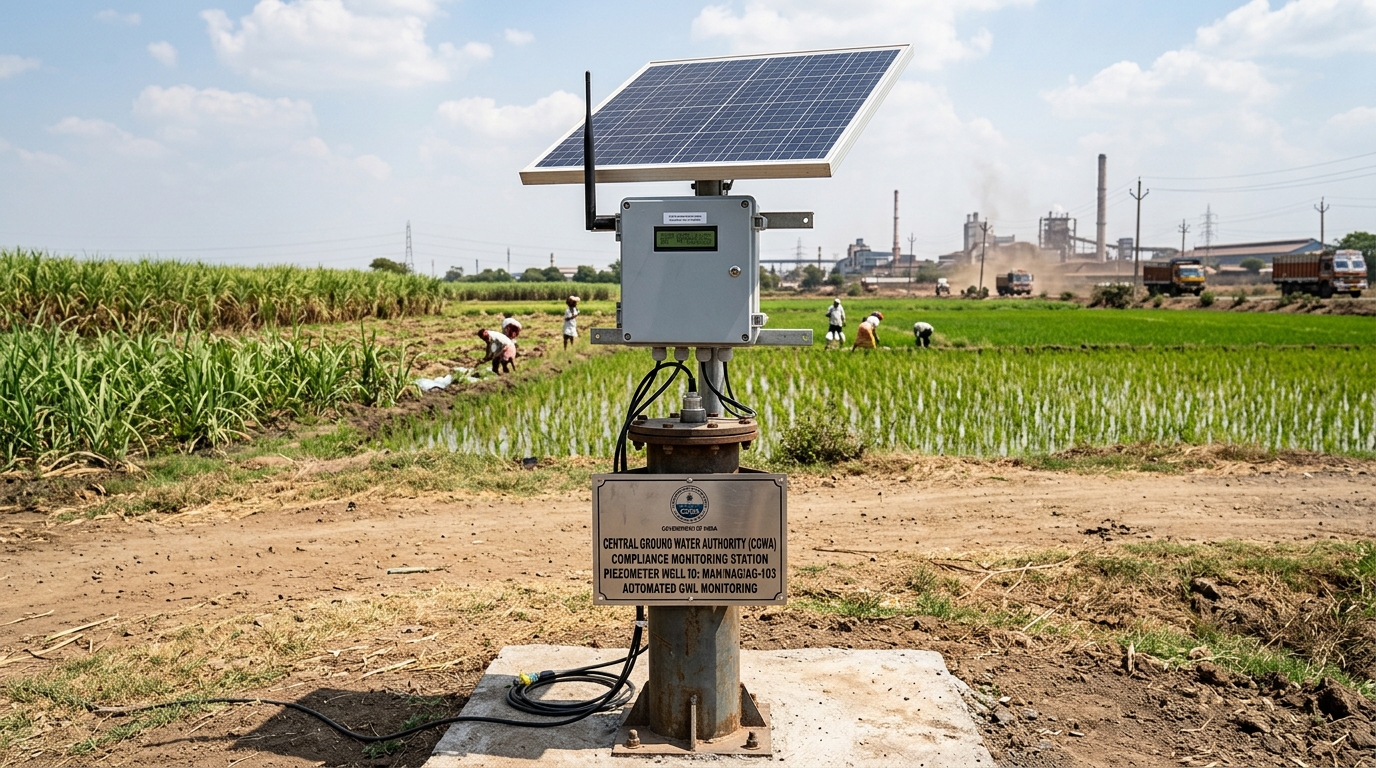
Satellite radar interferometry (InSAR) and GRACE gravimetry identify alarming land sinking rates exceeding 45 mm/year in deltaic industrial basins across South and Southeast Asia.
In brief
On October 2, 2026, Nature Water published a groundbreaking global hydrological survey combining satellite radar interferometry (InSAR), GRACE gravity field telemetry, and localized piezometer arrays across 40 coastal delta cities. The study reveals that deep fossil groundwater pumping by industrial parks and urban agglomerations is causing irreversible geological aquitard compaction, driving coastal land subsidence at rates up to 45 millimeters per year and magnifying relative sea-level rise risks.
When coastal cities and industrial mega-hubs experience water shortages, the standard emergency response has always been the same: drill deeper borewells. Pumping from deep confined aquifers (150 to 300 meters below the surface) provides reliable, clean freshwater. But the physical consequences beneath the surface are catastrophic.
The Mechanics of Irreversible Aquitard Compaction
Confined deep aquifers are structured like complex geologic sponges, composed of permeable sand and gravel layers separated by fine-grained clay silt beds (aquitards). Groundwater stored in pore spaces exerts hydraulic pressure that physically helps support the weight of overlying sediment and cities.
When intensive industrial extraction lowers the pore-water pressure, the structural load transfers directly to the clay grains. Water drains irreversibly from clay pores, causing the aquitard to compress like an empty dry sponge. Once clay compaction occurs, the pore space is permanently lost—even if rain recharges the region decades later, the ground cannot bounce back.
Magnifying the Risk of Coastal Flooding
In delta cities including Jakarta, Bangkok, Kolkata, and Houston, land subsidence is outpacing global climate-induced sea-level rise by a factor of four. As industrial zones sink below high-tide sea levels, coastal stormwater drainage channels reverse direction, and seawater inundation during seasonal cyclones penetrates deep into freshwater municipal intakes.
Coastal industrial clusters must establish immediate moratoria on deep confined aquifer extraction, switching to seawater desalination, municipal treated wastewater offtake, and managed recharge to stabilize the ground.
The Nature Water study delivers a stark warning: managing groundwater is not merely about water availability, but about keeping coastal cities from sinking into the ocean.
Why it matters
Proves that groundwater depletion is not just a water volume crisis, but a permanent structural hazard that sinks coastal cities and industrial ports beneath sea level.
Sources
Nature Water Journal & Global Hydrological Consortium (October 2, 2026)Read original ↗Nature Water Global Hydrology Research Publication↗Rispri Labs Hydrogeological Piezometric Monitoring & Aquifer Audits↗Found an error? See the Corrections Policy.
Image: Automated Digital Piezometer & Real-Time IoT Groundwater Monitoring Station