
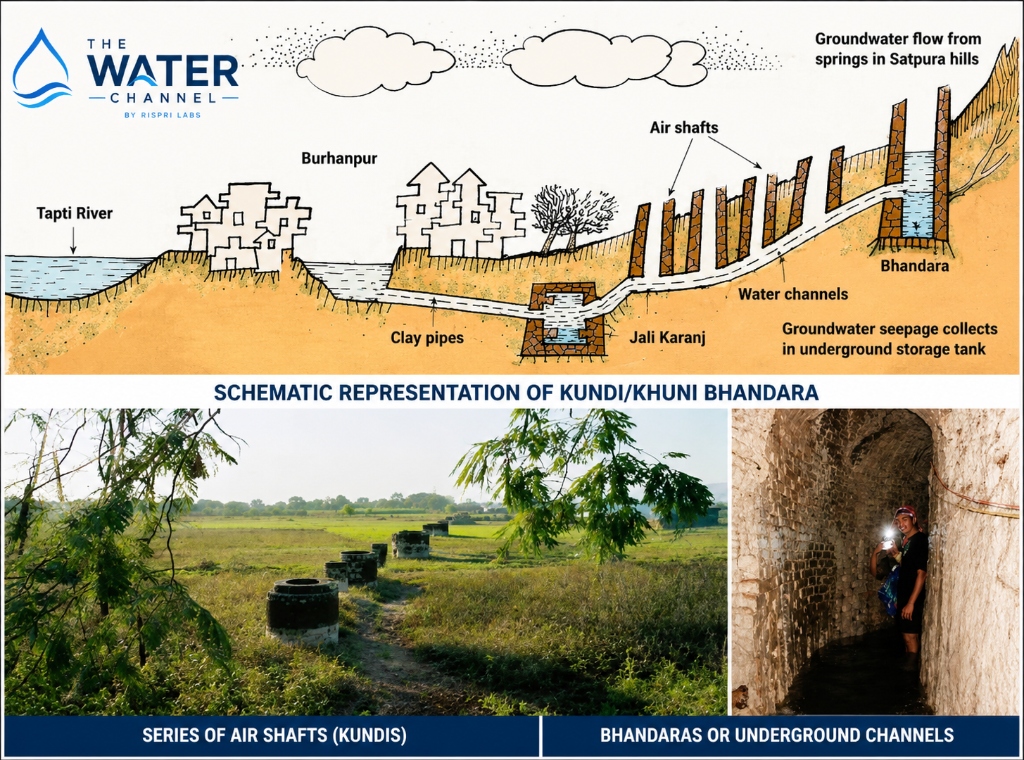
Hydraulic field evaluation of the 411-year-old Khooni Bhandara system demonstrates how sub-surface gravity infiltration tunnels can deliver clean groundwater without lowering catchment water tables.
In brief
A comprehensive geotechnical and hydraulic study of Burhanpur's 411-year-old Khooni Bhandara subterranean aqueduct published on October 14, 2026, highlights how Mughal-era passive infiltration galleries offer a climate-resilient template for modern water engineering. By capturing perched aquifer seepage via gentle subterranean slopes (1:1,000 gradient), the system delivers continuous potable water with zero carbon emissions.
Constructed in 1615 CE under Mughal governor Abdur Rahim Khan-i-Khana, the Khooni Bhandara subterranean water conveyance network in Burhanpur, Madhya Pradesh, has functioned continuously for over four centuries. A newly published multidisciplinary hydrogeological assessment explores how its passive engineering principles apply to modern climate adaptation.
Gravity Infiltration and Hydraulic Gradient Design
The system taps the saturated alluvial apron at the base of the Satpura hills. Rather than employing deep tubewells that create steep cones of depression and deplete regional water tables, the builders excavated a series of interconnected vertical shafts and a subterranean lime-mortared tunnel that intercepts perched groundwater seepage purely along a gentle 1:1,000 hydraulic gradient.
The natural basalt and gravel strata act as a continuous geological slow sand filter, removing suspended sediment and biological pathogens. Water emerging at the surface distribution storage basins consistently meets modern drinking clarity standards without chemical coagulation or electrical pumping.
Civil engineers designing water supply schemes in drought-prone foothills are adapting qanat principles into horizontal riverbed collector wells and infiltration galleries, eliminating mechanical power vulnerability.
Preservation efforts supported by the Archaeological Survey of India are integrating digital 3D LiDAR scanning to safeguard this masterwork of sustainable hydraulic heritage.
Why it matters
Offers civil and hydrogeological engineers an authentic blueprint for designing zero-energy, gravity-driven groundwater infiltration systems that maintain natural riparian equilibria during extreme droughts.
Sources
International Journal of Historical Hydro-Engineering (October 14, 2026)Read original ↗Rispri Labs Khooni Bhandara Subterranean Hydrogeology Case Study↗UNESCO World Heritage Tentative List Mughal Waterworks↗Found an error? See the Corrections Policy.
Image: Mughal Subterranean Aqueduct & Khooni Bhandara Engineering Schematic