
Fresh water from the sea, with none of the toxic brine.
In brief
Researchers at the University of Rochester built a solar desalination device using laser - etched "superwicking" black metal that evaporates seawater into fresh water while capturing the leftover salts and minerals as a solid, rather than discharging them as concentrated brine.
Conventional desalination's dirty secret is brine: for every litre of fresh water produced, a concentrated, environmentally damaging waste stream has to go somewhere - usually back into the ocean near the outfall, at real ecological cost. A device out of Professor Chunlei Guo's lab at the University of Rochester, published in Light: Science & Applications in May 2026, sidesteps that problem at the design level rather than treating brine as an unavoidable byproduct.
How "superwicking" black metal actually works
The panel surface is textured with femtosecond lasers into a structure that absorbs nearly all incoming sunlight and strongly draws water across itself - the "superwicking" property. An active region pulls a thin film of seawater across the textured surface, absorbs solar radiation efficiently enough to distill it, and pushes the leftover salts and minerals outward into a separate, untreated "passive" region of the same panel. Because the salt deposits away from the active desalinating surface, it doesn't clog the mechanism the way scaling normally does in solar stills - the panel keeps working continuously instead of fouling.
An unplanned second use: pulling out lithium
A companion study from the same group, published in the Journal of Materials Chemistry A, found they could adapt the identical panel design to separate lithium from the other salts left behind after desalination, by embedding hydrogen - titanate nanoparticles into the laser - etched grooves. Lithium demand is currently driven almost entirely by battery manufacturing - so a desalination byproduct stream that can be selectively mined for it is a meaningfully different economic proposition than brine that's purely a disposal cost.
This is genuinely lab-stage work, not a commercial product - but the lithium-extraction spin-off is the detail worth watching more than the desalination result itself. A byproduct stream from desalination that can be selectively mined for battery-grade lithium is a different economic proposition entirely from brine that exists purely as a disposal cost, and that's the kind of shift that tends to accelerate funding once it's demonstrated at even a small commercial scale.
Why it matters
Brine disposal is one of the hardest and most environmentally contentious parts of desalination - a lab - scale process that sidesteps it entirely is worth watching as it scales toward commercial viability.
Found an error? See the Corrections Policy.
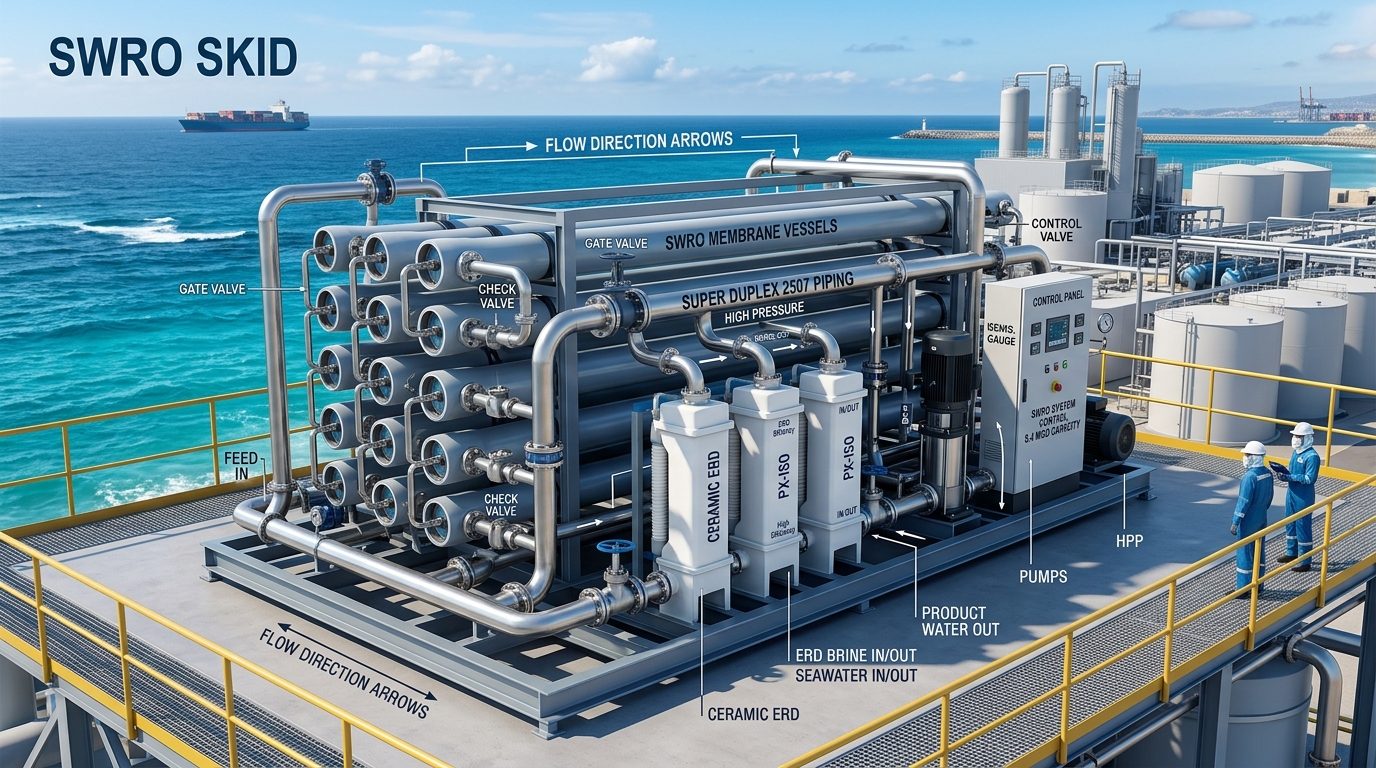
Image: Seawater Reverse Osmosis (SWRO) Membrane Vessels & Isobaric Energy Recovery