
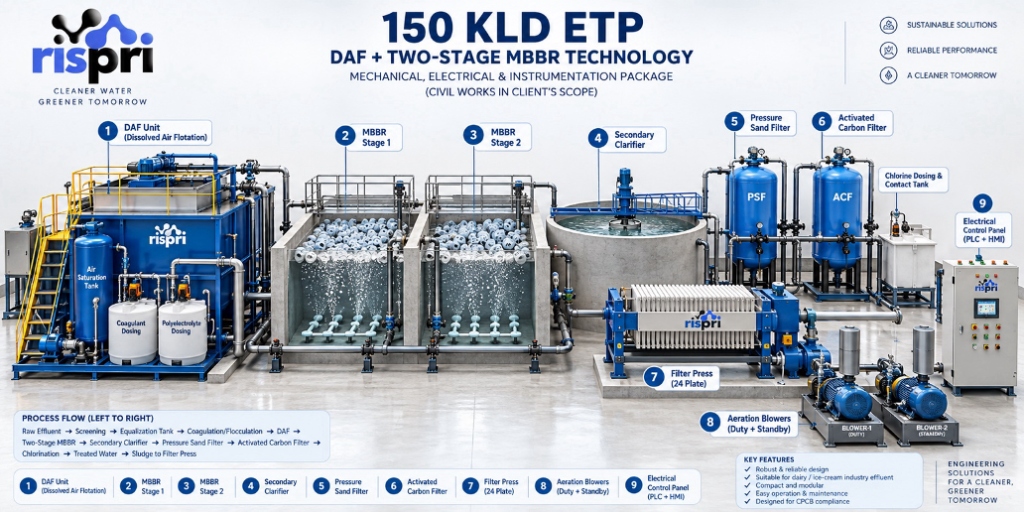
High-surface-area carrier geometries (>1,200 m²/m³) harbor dense autotrophic nitrifying biofilms, allowing wastewater treatment plants to double biological capacity without civil expansions.
In brief
Applied environmental biotechnology research published on October 17, 2026, confirms that newly developed virgin high-density polyethylene (HDPE) biofilm carriers with micro-grooved surface topographies boost protected active surface area beyond 1,200 m²/m³. In full-scale industrial trials, the media achieved complete nitrification at 25% lower aeration blower power while doubling biological throughput.
Moving Bed Biofilm Reactor (MBBR) systems rely on submerged, constantly moving plastic carrier media to support biological growth. However, conventional carrier designs often suffer from internal biomass clogging, inadequate mass transfer, and low autotrophic nitrification rates when subjected to high organic shock loads.
Engineered Surface Micro-Grooves and Hydrodynamics
The research team engineered injection-molded virgin HDPE carriers featuring spiral internal fins and micro-grooved surface texturing. The design achieves an active protected specific surface area of 1,240 m²/m³ while promoting turbulent fluid mixing that shears off sloughed, inactive dead biomass while sheltering fragile Nitrosomonas and Nitrobacter colonies.
In comparative industrial ETP trials treating chemical synthesis wastewater with ammonia concentrations of 120 mg/L, the micro-grooved carriers achieved 99% ammonium conversion at a hydraulic retention time (HRT) of only 4.2 hours, requiring 25% lower specific dissolved oxygen levels than smooth-wall carriers.
Retrofitting an overloaded activated sludge basin into an Integrated Fixed-Film Activated Sludge (IFAS) or MBBR system using high-surface carriers enables 100% capacity expansion inside the existing civil tank footprint.
The durable virgin HDPE media demonstrated zero structural wear or embrittlement over 36 months of continuous agitation, setting a new benchmark for biological reactor revamping.
Why it matters
Allows industrial plants and municipal STPs constrained by physical plot space to meet stringent ammoniacal nitrogen discharge limits without building additional concrete aeration tanks.
Sources
Bioresource Technology Journal (October 17, 2026)Read original ↗Bioresource Technology Biofilm Carrier Engineering Research↗Rispri Labs Industrial Moving Bed Biofilm Reactor (MBBR) Engineering↗Found an error? See the Corrections Policy.
Image: Industrial Effluent Treatment Plant (ETP) Process Flow & DAF/MBBR Clarifier