
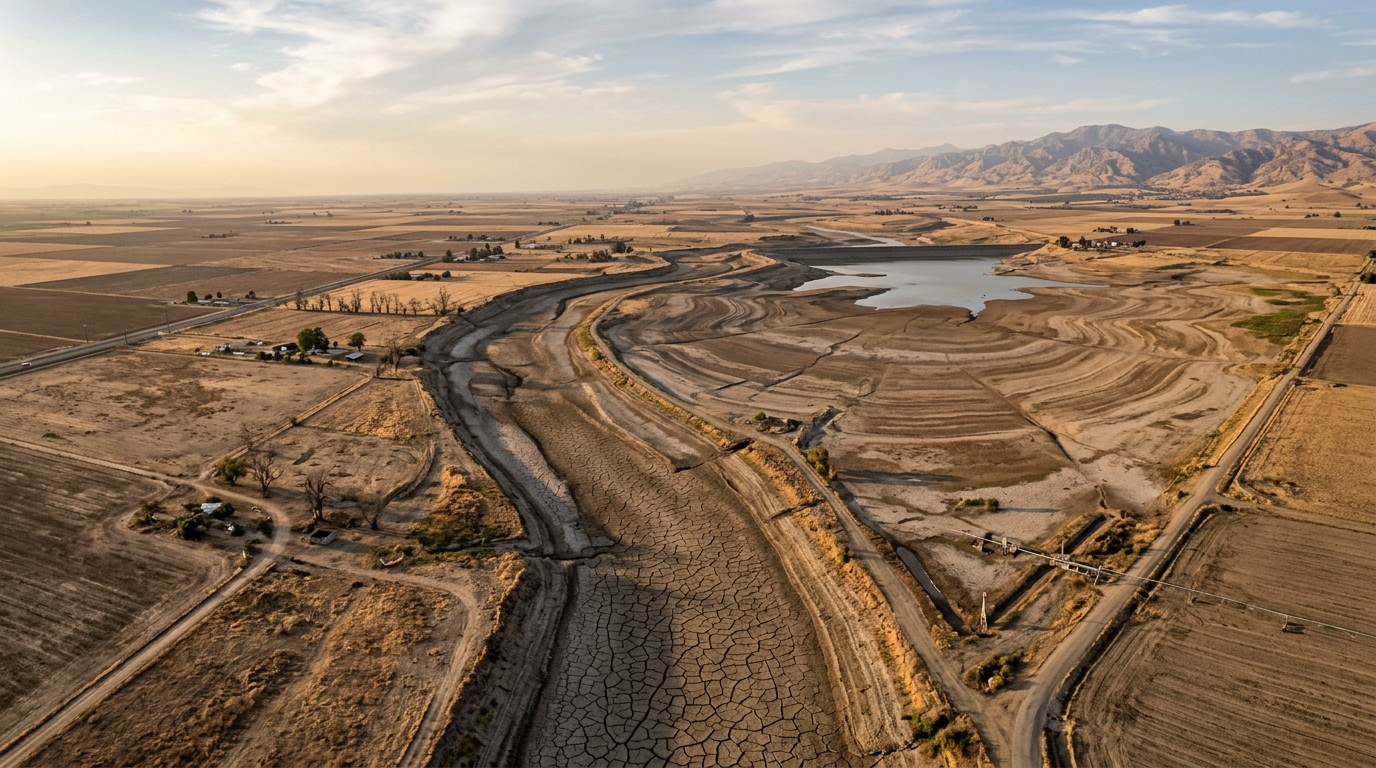
Global hydro-climatic assessment reveals persistent root-zone dryness, shrinking mountain snowpacks, and below-average reservoir recharge across major continental breadbaskets.
In brief
The World Meteorological Organization (WMO) released its landmark 2026 State of Global Water Resources Report on October 9, 2026, synthesizing satellite gravimetry, ground hydrological gauges, and climate modeling across 190 member nations. The findings indicate that more than 55% of global catchment areas experienced below-average hydrological inflows and unprecedented soil moisture drying throughout 2026, threatening agricultural yields and municipal raw water security.
The World Meteorological Organization (WMO) has issued its comprehensive 2026 State of Global Water Resources assessment, presenting an authoritative overview of streamflow, terrestrial water storage, and root-zone soil moisture across the planet.
Persistent Drying Across Agricultural Breadbaskets
The report highlights that more than half of global catchment areas documented below-average river discharge in 2026. From the Indus and Ganges-Brahmaputra basins in South Asia to the Mississippi and Danube corridors in the West, erratic rainfall patterns coupled with record-setting evaporative demand have depleted shallow soil moisture reserves, forcing farmers and industrial operators to accelerate deep aquifer abstraction.
Crucially, mountain snowpack storage—often described as the world's natural water towers—showed a 14% contraction relative to the 1991–2020 climatological baseline. In glacier-fed river systems across Central Asia and the Himalayas, early spring melt pulses led to severe late-summer baseflow deficits, severely restricting downstream canal withdrawals.
Implications for Industrial Plant Water Security
For industrial plants relying on surface canals or unconfined groundwater wells, these findings underline the immediate necessity of water stewardship. Water-intensive facilities must transition from once-through cooling toward closed-loop cooling towers, high-recovery membrane recycling, and localized rainwater percolation trenches to safeguard against seasonal surface allocation cuts.
Industrial facilities situated in drought-sensitive basins should verify their statutory storage capacity and ensure on-site treated water buffers can sustain at least 15 days of continuous operations during dry spells.
The WMO urged international development institutions and national water ministries to accelerate investments in early warning systems, hydrometric telemetry, and cross-border river basin treaties before climate-induced water stress destabilizes regional food and energy systems.
Why it matters
Demonstrates that hydrological extremes are no longer isolated cyclical anomalies, requiring water utilities and industrial parks to treat freshwater scarcity as an operational baseline.
Sources
World Meteorological Organization Hydrology & Water Resources Department (October 9, 2026)Read original ↗WMO Global Hydrological Status and Outlook System (HydroSOS)↗Rispri Labs Aquifer Monitoring & Hydrogeological Auditing↗Found an error? See the Corrections Policy.
Image: Global Hydrological Assessment & Arid River Basin Soil Moisture Deficit