
Shop-floor troubleshooting guide: how to diagnose Sludge Volume Index (SVI) creep, dissolved oxygen paradoxes, and foam color shifts 48 hours before clarifier failure.
In brief
On October 7, 2026, the Industrial Wastewater Operations Technical Committee published an updated shop-floor diagnostic playbook for biological wastewater treatment operators. Sludge bulking and secondary clarifier overflow rarely occur instantaneously; activated sludge tanks exhibit unmistakable distress signals 48 to 72 hours in advance, including Sludge Volume Index (SVI) creep past 150 mL/g, foam color shifts, and dissolved oxygen depression.
For every industrial wastewater plant engineer, few sights are more alarming than secondary clarifier carryover. Walking into the plant to discover a murky brown blanket of un-settled sludge spilling over the collection weirs into the treated sump means compliance violation, turbidity sensor alarms, and potential regulatory scrutiny.
The Fatal Flaw of Panic Chemical Dosing
When clarifier carryover occurs, operators often react by dumping massive doses of polyaluminium chloride (PAC) or liquid chlorine into the aeration tank in a frantic attempt to weigh down the sludge. In biological systems, this often backfires: excess coagulants disrupt biological floc charge, while chlorine wipes out beneficial nitrifying bacteria, completely collapsing the plant's biological performance.
Sludge bulking is almost always preventable if operators track three early indicators: Daily 30-minute graduated cylinder settling tests that reveal Sludge Volume Index (SVI) climbing above 150 mL/g; shifting foam color codes (crisp white frothy foam indicates young sludge with high F/M ratio, while greasy chocolate foam points to Nocardia blooms caused by high sludge age or fat/oil ingress); and DO drops despite 100% blower operation.
Actionable Triage Protocol
Instead of shock coagulants, plant managers should follow a disciplined three-step triage: Immediately adjust the Return Activated Sludge (RAS) pumping rate to prevent sludge blanket compaction in the clarifier; verify the equalization tank pH and retention time to catch shock organic loads from upstream production; and measure the influent BOD:N:P nutrient ratio.
In industrial wastewater, maintaining a strict 100:5:1 ratio of BOD:Nitrogen:Phosphorus is mandatory. Nutrient deficiency—especially nitrogen starvation—is the #1 silent trigger for filamentous organism proliferation.
By mastering simple microscopic Gram staining and maintaining balanced biological nutrition, wastewater operators can run stable, crystal-clear clarifiers year-round.
Why it matters
Prevents catastrophic biological washouts and emergency chemical overdosing by teaching plant engineers to stabilize bacterial health through proactive operational tuning.
Sources
Water Environment Federation (WEF) Operations Manual & Plant Case Archives (October 7, 2026)Read original ↗Water Environment Federation Activated Sludge Process Control Guidelines↗Rispri Labs Biological ETP Troubleshooting & MLSS Diagnostics↗Found an error? See the Corrections Policy.
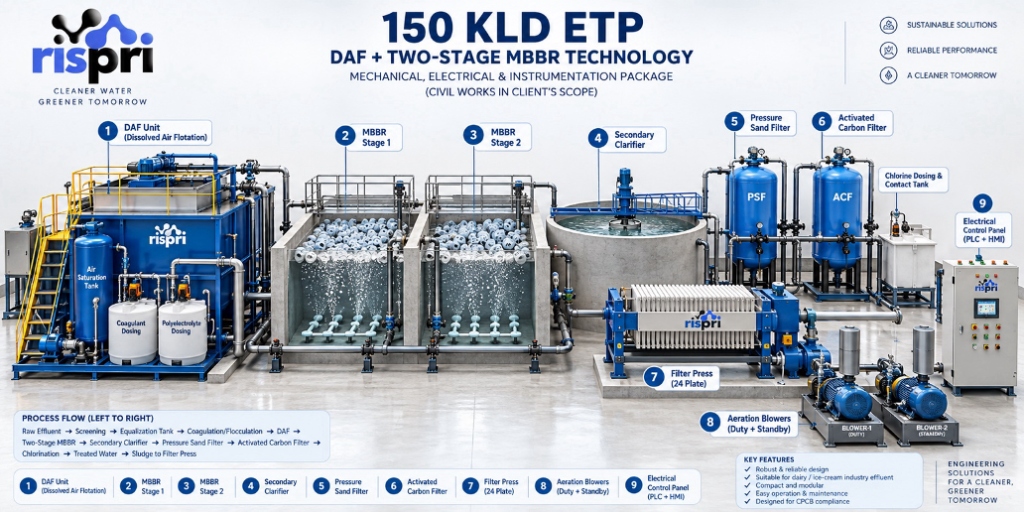
Image: Industrial Effluent Treatment Plant (ETP) Process Flow & DAF/MBBR Clarifier