
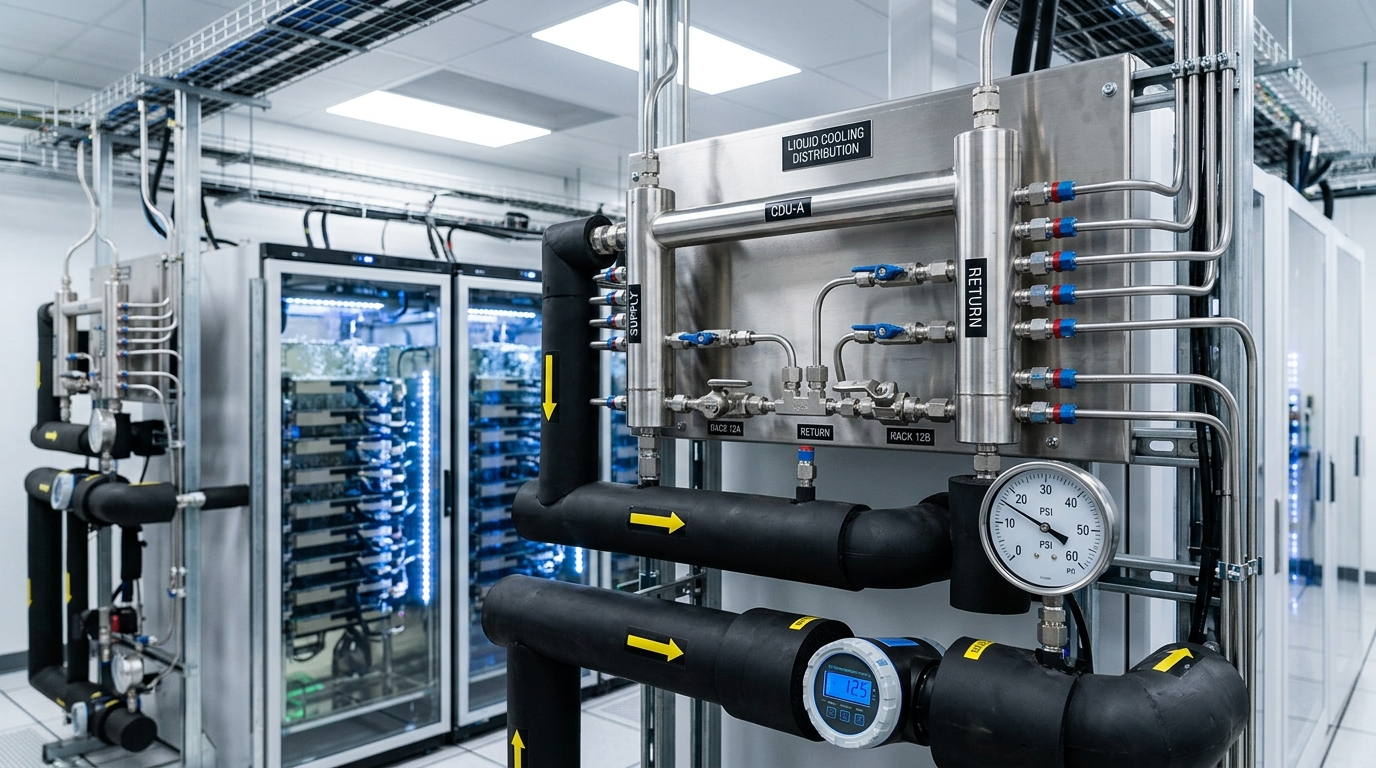
As generative AI compute pushes server rack densities beyond 100 kW, operators phase out open cooling towers in favor of hermetic refrigerant loops with zero on-site water loss.
In brief
Technical disclosures unveiled at the ASHRAE Data Center Thermal Conference on October 11, 2026, confirm that hyperscale operators are rapidly retiring evaporative cooling towers in favor of closed-loop, two-phase direct-to-chip liquid cooling. Confronting severe community pushback and municipal water quotas in arid data center hubs, the hermetic dielectric refrigerant loops reduce on-site Water Usage Effectiveness (WUE) to near zero.
The rapid deployment of high-density AI computing accelerators has driven individual server rack thermal loads from 15 kW to over 130 kW. Historically, data center operators relied on massive evaporative cooling towers—which evaporate between 1.0 and 2.0 liters of drinking water for every kilowatt-hour of compute energy—triggering regulatory moratoriums in water-stressed regions.
Dielectric Phase-Change Thermodynamics
The newly standardized architecture employs two-phase direct-to-chip cooling. A non-conductive dielectric fluid is circulated through micro-channel cold plates mounted directly on high-performance GPU processors. The fluid boils at low temperatures, absorbing enormous latent heat via liquid-to-vapor phase transition.
The vaporized refrigerant travels through hermetic piping to external dry heat rejection coils, where ambient air condenses it back to liquid form in a completely closed loop. Because no cooling water is ever sprayed or evaporated into the atmosphere, direct facility water consumption is completely eliminated.
A standard 100-megawatt AI data center campus transitioning from evaporative towers to closed-loop two-phase cooling conserves more than 450 million liters of potable municipal water annually.
ASHRAE's updated energy and water efficiency standards now heavily penalize evaporative cooling in water-stressed basins, accelerating the industry's shift toward zero-water thermal architectures.
Why it matters
Resolves the growing conflict between generative AI computing growth and municipal freshwater scarcity, eliminating the millions of daily gallons traditionally evaporated by computer cooling towers.
Sources
ASHRAE Technical Committee on Mission Critical Facilities (October 11, 2026)Read original ↗ASHRAE Standard 90.4 Data Center Energy and Water Efficiency↗Rispri Labs Industrial Cooling Water Auditing & Water Balance Services↗Found an error? See the Corrections Policy.
Image: Enterprise Data Center Closed-Loop Liquid Cooling Distribution Infrastructure