
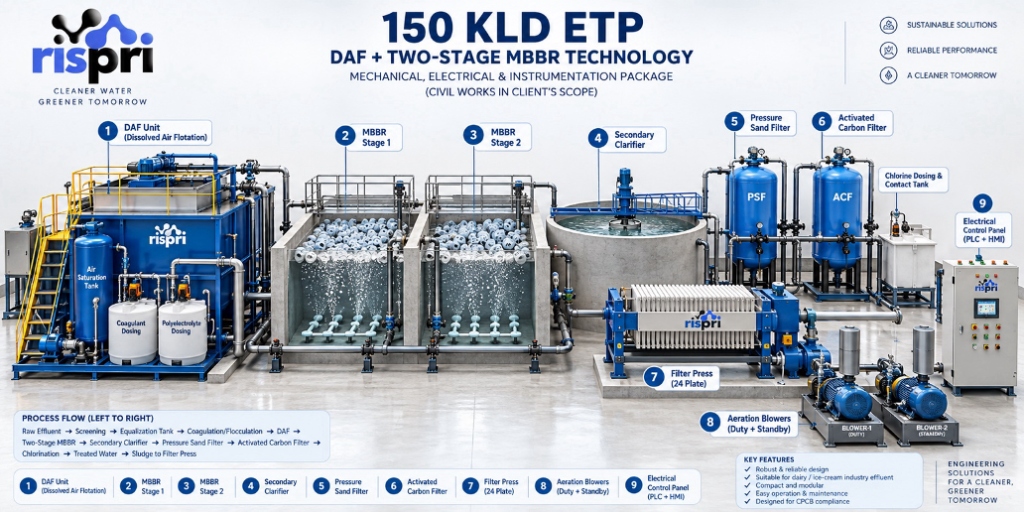
Micro-bubble saturation vessels operating at 6 bar generate 20–40 micron bubbles, lifting emulsified hydrocarbons and preventing biological carrier fouling in downstream MBBR reactors.
In brief
Engineering performance benchmarks released on October 17, 2026, demonstrate that modern automated Dissolved Air Flotation (DAF) units equipped with dual micro-bubble saturation manifolds achieve 98.7% separation of free and emulsified oil from industrial wastewater. The high-rate clarifiers safeguard downstream biological media and reverse osmosis membranes from catastrophic hydrocarbon blinding.
Effluents from edible oil refining, dairy processing, petrochemical operations, and automotive machine shops carry severe concentrations of emulsified oils, greases, and suspended fatty acids. If allowed to enter biological aeration basins, oily coatings smother microbial flocs and irreversibly foul aeration diffusers and ultrafiltration membranes.
Hydrodynamic Saturation and Micro-Bubble Kinetics
The tested automated DAF units recycle 25% of treated effluent through a multi-phase dissolution vessel operating at 5.5 to 6.2 bar. Pressure letdown nozzles release millions of micro-bubbles with diameters strictly controlled between 20 and 40 microns. The bubbles attach directly to destabilized oil droplets, accelerating upward rise velocities beyond 15 meters per hour.
Automated variable-speed surface scrapers continuously skim the buoyant floating sludge layer into dry collection hoppers, achieving dry solids concentrations up to 6.5%, dramatically reducing sludge dewatering chemical costs downstream.
Maintaining effluent oil and grease below 5 mg/L ahead of secondary biological and tertiary membrane systems extends reverse osmosis membrane element lifespan from 12 months to over 48 months.
Industrial manufacturing plants undergoing capacity expansions are adopting containerized DAF skids as standard primary clarification stages to guarantee statutory discharge compliance.
Why it matters
Hydrocarbon breakthrough into biological aeration basins rapidly suffocates nitrifying bacteria and coats membrane surfaces; automated DAF eliminates this single largest operational failure mode.
Sources
Journal of Water Process Engineering (October 17, 2026)Read original ↗Journal of Water Process Engineering Flotation Technologies Special Issue↗Rispri Labs Automated DAF & Chemical Clarification Engineering↗Found an error? See the Corrections Policy.
Image: Industrial Effluent Treatment Plant (ETP) Process Flow & DAF/MBBR Clarifier