
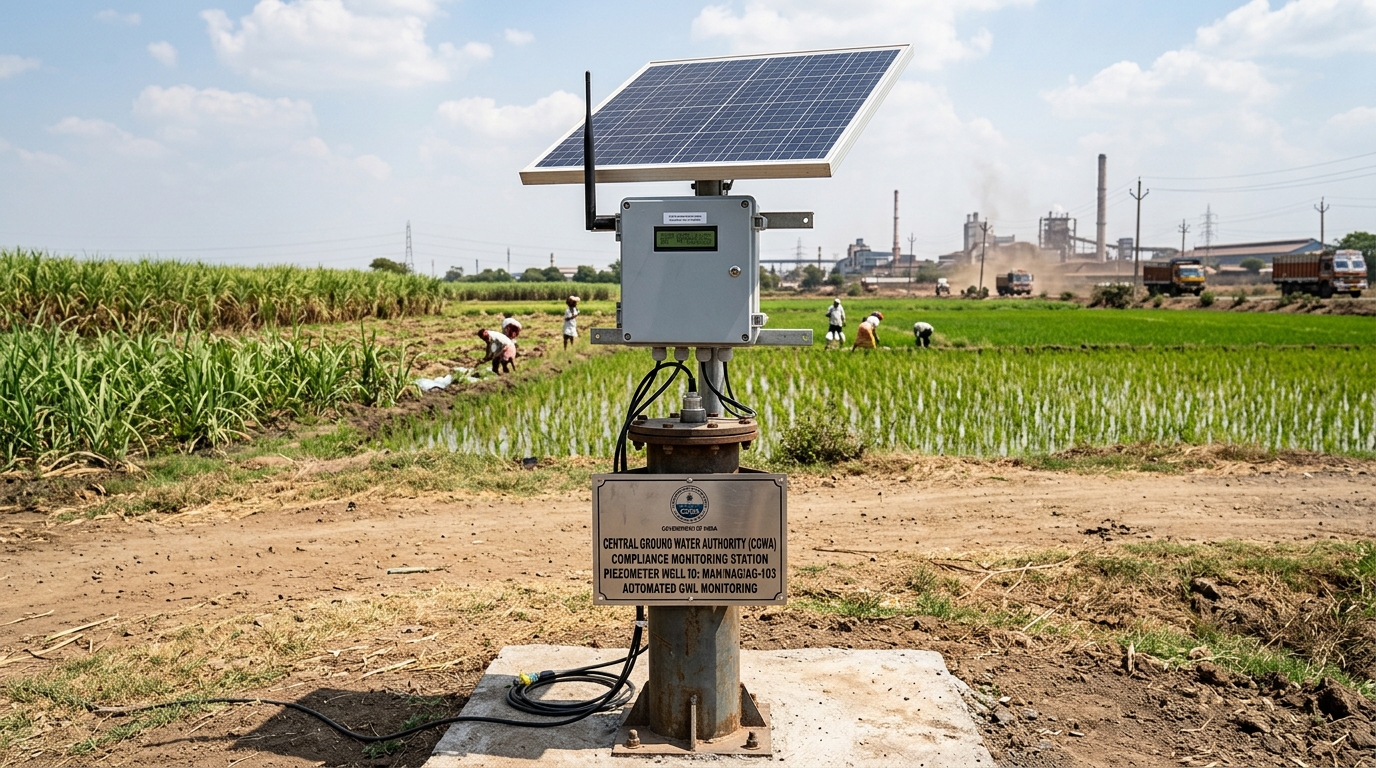
Every drop now tracked in real time - CGWA's telemetry mandate changes the compliance game.
In brief
Under the 2026 groundwater rules, industrial and commercial groundwater meters must be fitted with real - time telemetry that transmits withdrawal data directly to CGWA servers, letting the regulator flag unauthorised extraction as it happens rather than at the next audit cycle.
The headline change is simple: groundwater withdrawal in India is no longer something you report after the fact. Under the revised CGWA framework, extraction has to be metered, logged, and - above a defined threshold - transmitted to the regulator automatically, on a rolling basis. The rule doesn't apply uniformly; it scales with how much water a facility actually pulls.
The two thresholds that matter
Any proponent drawing 10 m³/day or more of groundwater must construct a purpose - built observation well - a piezometer - for monthly water - level monitoring. That's the baseline. It's a comparatively low bar: a mid - sized processing unit or a large commercial building could easily clear it.
Cross that second threshold and the requirement escalates from "install a monitoring well" to "wire it up." At least one piezometer on site needs an automated telemetry system, and the facility has to hand over its portal login credentials - user ID and password - so CGWA can pull the data directly rather than relying on self - reported figures.
The physical specification, not just the policy
This isn't a paperwork - only change. CGWA's guidelines specify the piezometer itself: it must sit at least 50 metres from the well actually being pumped, run 4 to 8 inches in diameter, and be drilled to match the depth of the main pumping well - close enough to reflect real drawdown, far enough to avoid interference from the pump itself. Installation has to be completed within 30 days of the NOC being granted, with confirmation filed back to CGWA through the portal.
Once installed, the obligation doesn't end. Water - level data has to keep flowing to the CGWA web portal on a monthly cadence indefinitely - this is a standing operational requirement, not a one - time commissioning step.
The 50-metre separation and diameter specifications aren't bureaucratic box-ticking either - they exist so the piezometer reflects genuine aquifer drawdown rather than noise from the pumping well sitting right next to it. Worth checking before assuming compliance: whether your facility's telemetry data is actually being reviewed against these thresholds, or just quietly accumulating in a portal nobody's watching.
Why it matters
Any industry abstracting groundwater in bulk should assume metering - and - reporting is now continuous, not annual. Water audits (already mandatory above 100 m3/day, with a 3 - year 20% reduction target) will increasingly be cross - checked against this live data.
Sources
India Water ReviewRead original ↗CGWA (official digital flow meter + telemetry specification)↗Found an error? See the Corrections Policy.
Image: Automated Digital Piezometer & Real-Time IoT Groundwater Monitoring Station