
Mandate eliminates single-wavelength turbidity interference and establishes cryptographic tamper-proofing for real-time COD, BOD, and TSS telemetry transmissions.
In brief
On October 10, 2026, the Central Pollution Control Board (CPCB) notified an updated technical directive for Online Continuous Effluent Monitoring Systems (OCEMS) installed across all Common Effluent Treatment Plants (CETPs) and grossly polluting industrial units. The directive prohibits single-wavelength optical probes prone to drift, mandating full UV-Vis double-beam spectral absorption analyzers with automatic cleaning and cryptographic data hashing.
The Central Pollution Control Board (CPCB) has issued a comprehensive revision of its Online Continuous Effluent Monitoring System (OCEMS) architecture. The revised guidelines address persistent discrepancies between real-time sensor telemetry and grab-sample laboratory results across CETPs in major chemical, textile, and tanning clusters.
Full UV-Vis Spectroscopy and Turbidity Compensation
Earlier single-beam sensors operating at single wavelengths (typically 254 nm) often suffered from severe baseline drift and false COD readings caused by background particulate turbidity and colloidal color. The new directive mandates double-beam spectrometers scanning the full 200–750 nm spectrum with automated optical path air-blast cleaning.
To prevent data manipulation, all analyzer data loggers must incorporate asymmetric public-key cryptographic signatures (SHA-256) at the sensor head. Any telemetry disruption exceeding two hours automatically flags the facility on the central SPCB compliance dashboard.
CETP operators must conduct monthly split-sample calibrations verified by an independent NABL-accredited environmental laboratory to validate the spectrometer's mathematical regression matrix.
Facilities have been given until January 15, 2027, to complete hardware replacements and register certified instrumentation with central servers.
Why it matters
Eliminates sensor calibration tampering and turbidity false readings, giving regulatory authorities an uncompromised 24x7 telemetry record of industrial cluster discharge compliance.
Sources
Central Pollution Control Board Technical Circular (October 10, 2026)Read original ↗CPCB OCEMS Server Guidelines and Protocol Specifications↗Rispri Labs OCEMS Calibration & NABL Verification Services↗Found an error? See the Corrections Policy.
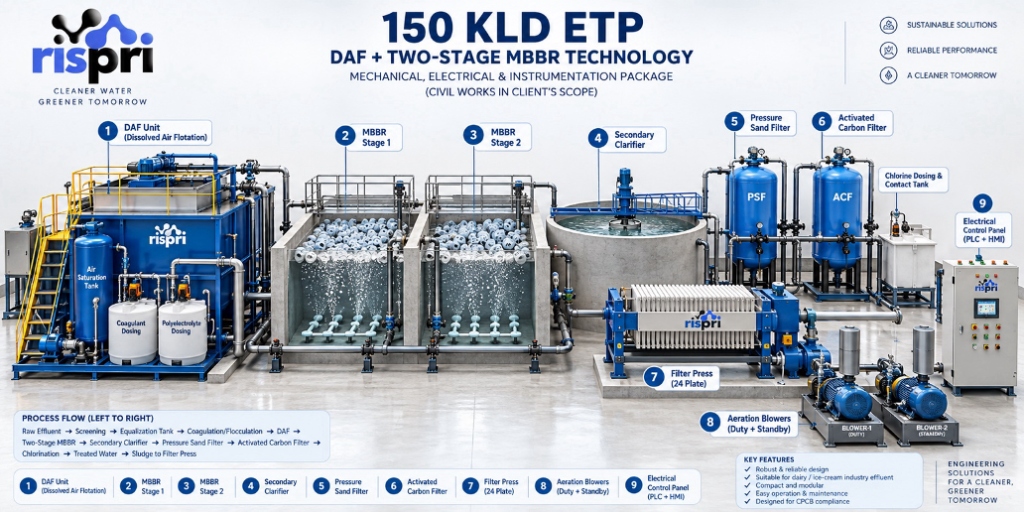
Image: Industrial Effluent Treatment Plant (ETP) Process Flow & DAF/MBBR Clarifier