
Fish survival testing and real-time cloud data streaming become mandatory for chemical, caustic soda, and industrial units across India.
In brief
The Central Pollution Control Board (CPCB) and State Pollution Control Boards have enforced updated compliance protocols requiring industrial facilities - including caustic soda, chemical synthesis, and pharmaceutical units - to perform 96-hour fish bioassay survival testing and stream live OCEMS telemetry directly to regulatory servers.
You can pass every chemical test on your discharge report and still fail compliance in India now - because as of August 2026, "compliant" no longer just means the right numbers on a lab sheet. It means a fish can survive four straight days in your treated water. The Central Pollution Control Board (CPCB) and State Pollution Control Boards (SPCBs) have paired biological toxicity testing with real-time digital surveillance for industrial effluent treatment plants, and together the two are reshaping what compliance actually looks like for chemical, caustic soda, pharmaceutical and industrial units nationwide.
96-Hour Fish Survival & Continuous Cloud Telemetry
The logic is straightforward once you see it: a chemical concentration limit tells you what's in the water, but a bioassay tells you what it actually does to something alive. So the new protocol requires undiluted treated effluent to keep fish alive for 96 hours straight, while separately, edge IoT devices on Online Continuous Effluent Monitoring Systems (OCEMS) stream flow, pH, COD, BOD, TSS and TDS straight to state pollution servers every 15 minutes - no more waiting for a quarterly inspection to find out something went wrong.
For a facility, that combination removes the old buffer zone where a plant could quietly drift out of spec between inspections. Miss the bioassay benchmark or trip a telemetry flag now, and the response isn't a warning letter next quarter - it's a 48-hour clock, with NABL-accredited lab verification the only way to stop a Consent to Operate suspension from becoming permanent. Worth watching next: whether SPCBs eventually extend the same bioassay standard to STPs handling only domestic sewage, which currently sit outside this specific mandate.
Why it matters
Traditional chemical concentration testing is now legally paired with biological toxicity benchmarks. Facilities unable to maintain 90% fish survival in treated effluent face CTO suspension and immediate operational audits.
Sources
CPCB National Industrial Effluent Standards Update 2026Read original ↗CPCB Official Effluent Portal↗Rispri Labs Accredited Effluent Testing Services↗Found an error? See the Corrections Policy.
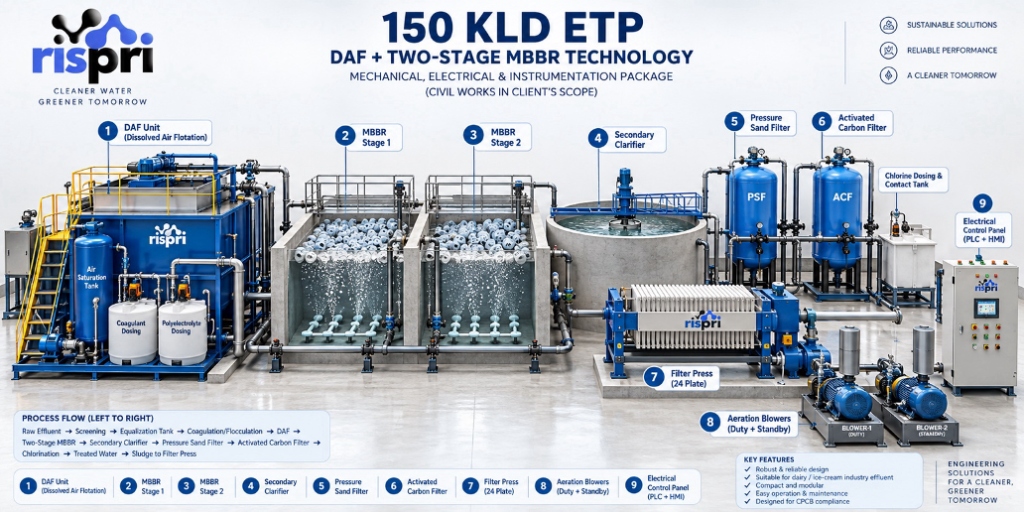
Image: Industrial Effluent Treatment Plant (ETP) Process Flow & DAF/MBBR Clarifier