
Electrochemical ion-exchange separation operates far beyond spiral RO scaling limits, unlocking 90% water recovery from reactive silica wastewater without chemical anti-scalants.
In brief
On October 5, 2026, the Mining and Geothermal Water Innovation Council announced the successful completion of a 12-month commercial trial of Electrodialysis Reversal (EDR) at a mineral processing facility in western North America. While standard reverse osmosis membranes foul irreversibly when reactive silica exceeds 120 ppm, the EDR system maintained a 90% water recovery rate on feed streams containing 250 mg/L of dissolved silica without chemical antiscalants.
In industrial water recycling, dissolved silica (SiO2) is widely feared by plant engineers as the 'glass-forming demon.' When water is concentrated through reverse osmosis membranes, silica polymerizes into colloidal gels and hard silicate scales that cannot be removed by acid or caustic clean-in-place (CIP) washings, permanently ruining expensive RO elements.
The Inherent Advantage of Electrochemical Separation
In reverse osmosis, hydraulic pressure forces water through sub-nanometer pores while salts and silica are left behind at the membrane surface, creating a concentration polarization boundary that triggers crystallization. In contrast, Electrodialysis Reversal (EDR) does not push water through membranes: an electric direct-current field pulls charged ions (Na+, Cl-, SO42-) through alternating cation and anion exchange membranes, leaving neutral water molecules behind.
Because non-ionized silica carries zero electrical charge at neutral pH, it simply passes through the EDR product flow channels without accumulating on the membrane face. Concentrations that would instantly destroy reverse osmosis membranes remain completely benign.
Self-Cleaning Polarity Reversal
The secret to EDR's decade-long membrane durability is its automated polarity reversal cycle. Every 15 to 20 minutes, the DC electrical polarity across the membrane stack is electronically swapped: positive electrodes become negative, and brine concentrate channels immediately become diluate product channels, automatically dislodging any nascent mineral scale and flushing it to the drain.
EDR is ideally suited for cooling tower blowdown, flue gas desulfurization (FGD) wastewater, and geothermal reinjection streams where high silica, calcium, and sulfate make standard RO economically unviable.
As industrial plants push toward higher water recovery in water-scarce mining corridors, electrodialysis reversal is re-emerging as a cornerstone of tough wastewater treatment.
Why it matters
Unlocks high-recovery wastewater recycling in geothermal energy, gold mining, and heavy industrial boiler blowdown where silica scaling previously forced massive water waste.
Sources
Desalination & Water Treatment Journal (October 5, 2026)Read original ↗International Desalination Association EDR Technical Review↗Rispri Labs Industrial Membrane Desalination & High-Recovery Audits↗Found an error? See the Corrections Policy.
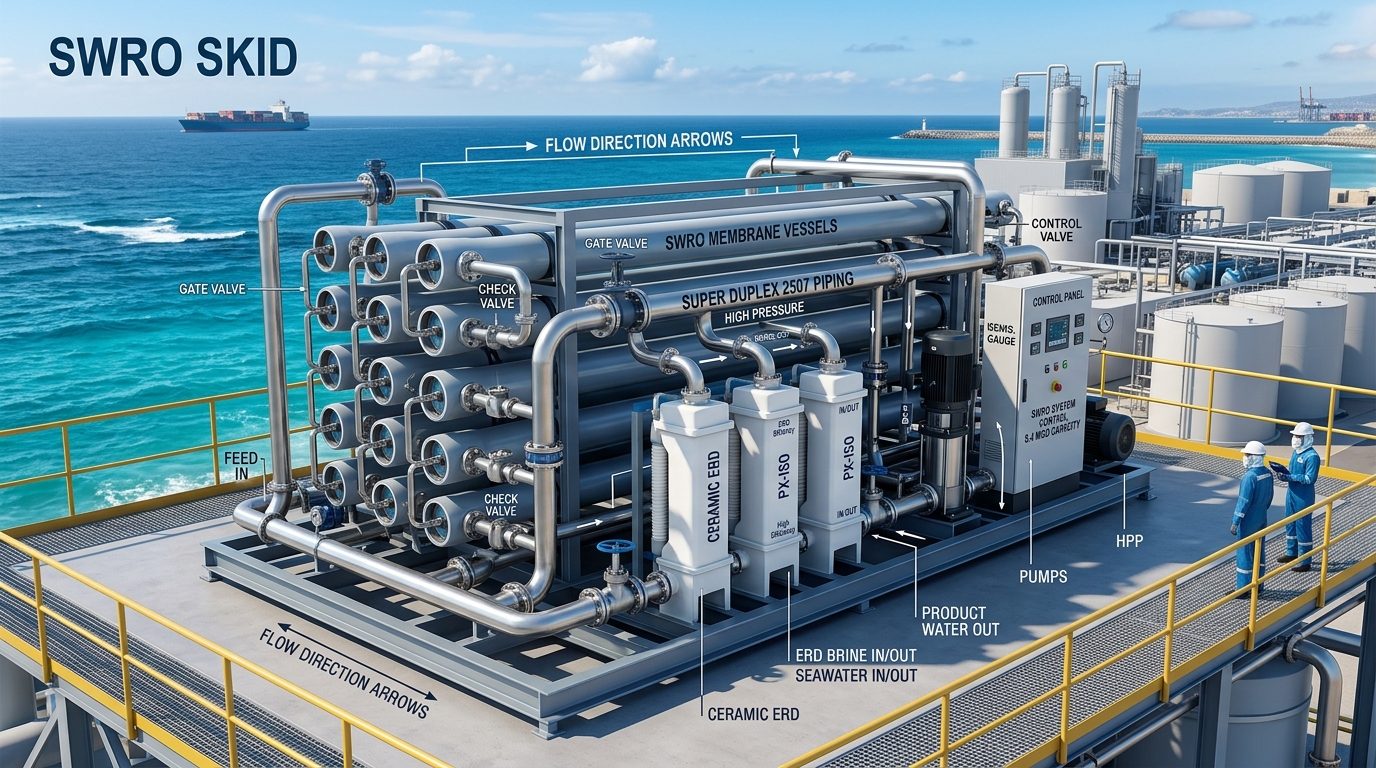
Image: Seawater Reverse Osmosis (SWRO) Membrane Vessels & Isobaric Energy Recovery