
Biomimetic aquaporin forward osmosis membranes extract 85% clean water from 180,000 ppm TDS dye-bath brine using thermo-reversible switchable draw solutions.
In brief
On October 3, 2026, membrane engineers in Tirupur and Singapore demonstrated a commercial pilot of Forward Osmosis (FO) coupled with low-temperature crystallization for treating spent textile reactive dye-bath effluent containing 180,000 ppm TDS. Using biomimetic hollow-fiber aquaporin membranes and thermo-reversible dimethylamine-CO2 switchable draw solutions, the system recovered 85% clean water without high-pressure pumps or thermal boiling.
Reactive dyeing of cotton fabric requires massive additions of sodium chloride or sodium sulfate (60 to 100 grams per liter) to force synthetic dyes onto cellulose fibers. The resulting spent dye-bath effluent has total dissolved solids (TDS) exceeding 150,000 ppm—far beyond the 70-bar physical burst pressure limit of conventional reverse osmosis membranes.
The Natural Physics of Osmotic Pressure
In reverse osmosis, hydraulic pumps must fight against natural osmotic pressure to push water out of brine. Forward Osmosis (FO) operates in the reverse direction: it harnesses natural osmotic pressure gradients. Water naturally flows across a semi-permeable membrane from low-osmotic-pressure wastewater into a concentrated, high-osmotic-pressure 'draw solution' with zero hydraulic pressure required.
The breakthrough system utilizes hollow-fiber membranes embedded with natural biological aquaporin water channels, providing exceptional water flux while rejecting 99.7% of organic dyes and salts. The draw solution consists of thermolytic dimethylamine and carbon dioxide (DMA-CO2).
Low-Temperature Thermal Draw Solution Recovery
Once water dilutes the draw solution, the mixture is gently warmed to just 58°C using waste low-grade plant steam. At this temperature, the DMA-CO2 gasifies and separates cleanly, condensing into pure liquid water while the gases are re-dissolved to reconstitute the draw solution in a closed loop.
Total specific energy consumption was 58% lower than operating a mechanical vapor recompression (MVR) thermal evaporator on the same hypersaline effluent.
Forward osmosis is rapidly proving that clever thermodynamic chemistry can solve extreme industrial water challenges where brute-force mechanical pumping reaches its physical limit.
Why it matters
Slashes electrical and steam costs by 58% in Zero Liquid Discharge textile dyeing plants where conventional reverse osmosis fails due to extreme osmotic pressure.
Sources
Journal of Membrane Science & Industrial Pilot Evaluation (October 3, 2026)Read original ↗Journal of Membrane Science Research Archive↗Rispri Labs Advanced Membrane Engineering & ZLD Consulting↗Found an error? See the Corrections Policy.
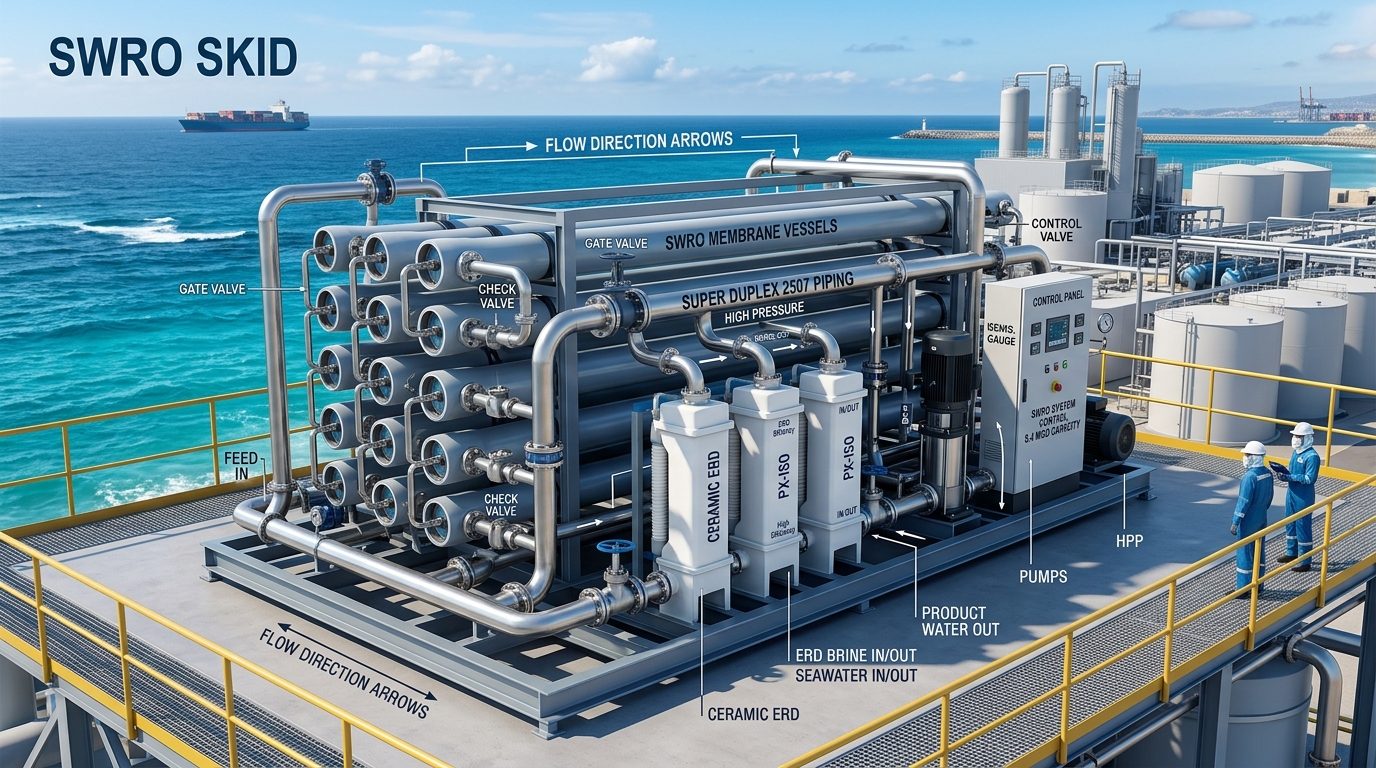
Image: Seawater Reverse Osmosis (SWRO) Membrane Vessels & Isobaric Energy Recovery