
No new industrial NOCs where the water table has already run dry.
In brief
CGWA's revised groundwater extraction norms bar new major industries from getting NOCs in blocks already classified as over - exploited, pushing new industrial water demand in those zones toward surface water, recycled water, or relocation.
India assesses its groundwater in units called blocks (also called taluks or mandals), rating each one from "safe" through "semi-critical" and "critical" to "over-exploited." That last category isn't a warning label - under CGWA's current norms, it's a hard stop for new large-scale industrial groundwater NOCs.
That's a slight improvement on the prior assessment, which put 751 of 6,749 units (11.13%) in the over - exploited category - but it still means roughly one in ten assessment units nationally has essentially no headroom left for new industrial extraction. Assessments have been conducted annually since 2022, having previously run only at periodic intervals, so this figure is now tracked far more closely than it used to be.
The regional picture is far worse than the national average
National figures flatten enormous regional variation. In Rajasthan, 214 of the state's 302 assessed units - roughly 71% - are classified over - exploited. In Haryana, it's 88 of 143 units, or 61.5%. For a business evaluating a new site in either state, the odds of landing in a restricted block are closer to a coin flip than an edge case.
What this means in practice
New major industries in over - exploited blocks are pushed toward alternatives - surface water allocation, recycled/treated water, or relocating the site entirely. None of those are drop - in substitutes for a groundwater - based design, which is exactly why this check needs to happen at the feasibility stage, not after a plant is already designed around a groundwater source.
The regional numbers are the part worth sitting with: a 71% over-exploited rate in Rajasthan and 61.5% in Haryana mean that for a new industrial site in either state, groundwater dependence isn't a minor design risk - it's closer to a coin flip on whether the NOC clears at all. That's exactly why a groundwater assessment-block check belongs at the feasibility stage, not the permitting stage.
Why it matters
Site - selection due diligence for any new plant now needs a groundwater assessment - block check as a first - pass filter, not an afterthought during the NOC application.
Sources
Drishti IASRead original ↗Press Information Bureau (Dynamic Groundwater Resource Assessment findings)↗Found an error? See the Corrections Policy.
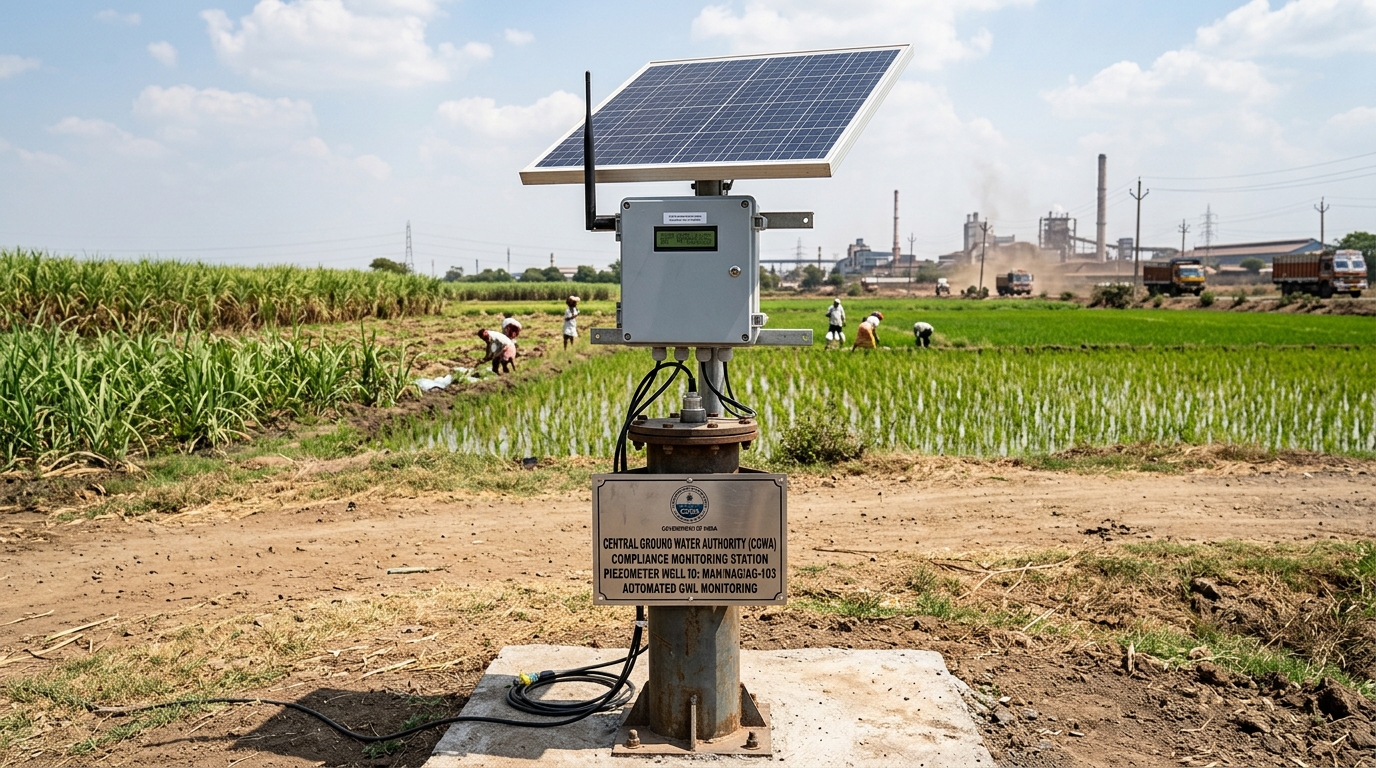
Image: Automated Digital Piezometer & Real-Time IoT Groundwater Monitoring Station