
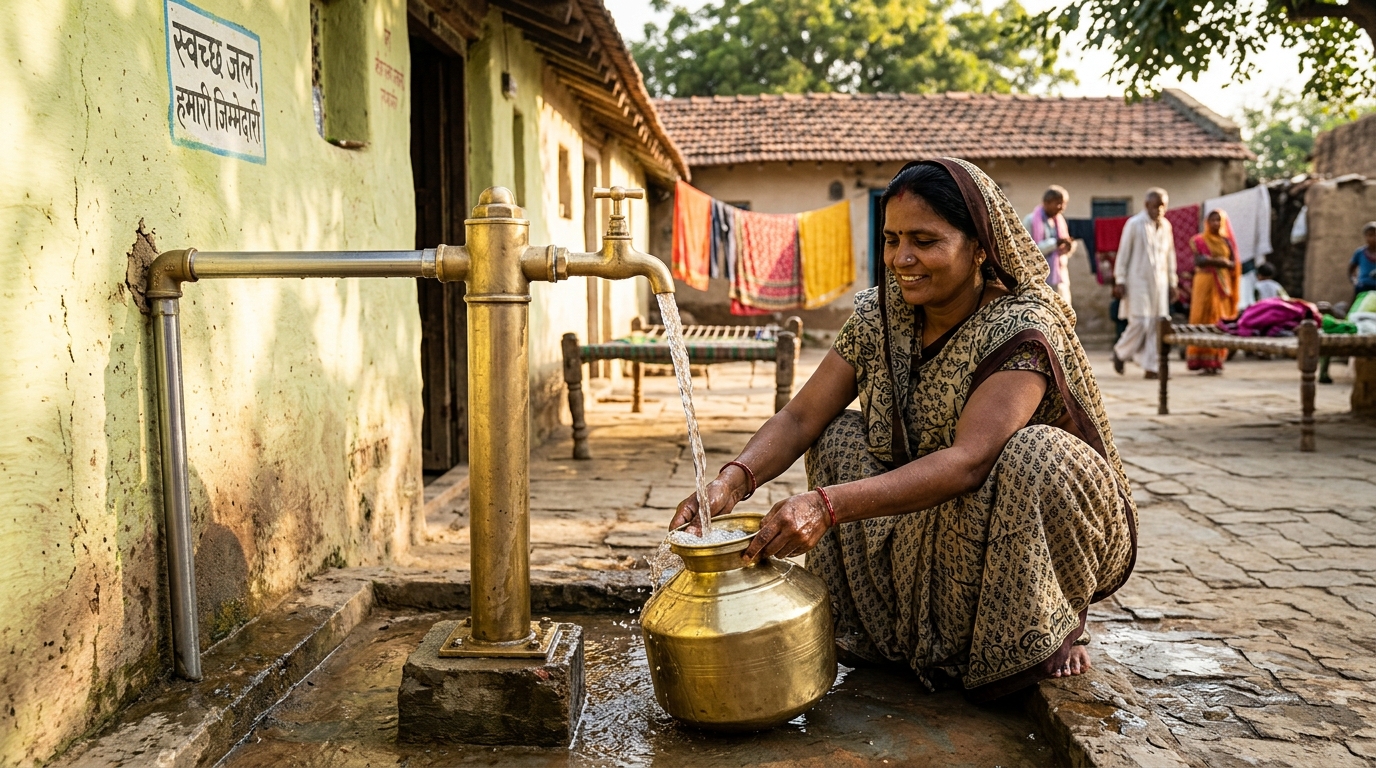
Over 152 million rural homes now receive piped drinking water, with real-time sensor gateways tracking residual free chlorine (0.2–0.5 mg/L) at village distribution headers.
In brief
On October 12, 2026, the Department of Drinking Water and Sanitation announced that the Jal Jeevan Mission has crossed 82.6% coverage, delivering functional tap water connections to more than 152 million rural households across India. The milestone is reinforced by the nationwide deployment of solar-powered IoT chlorine telemetry units that transmit real-time disinfection levels directly to public dashboards.
The flagship Jal Jeevan Mission (Har Ghar Jal) has achieved another transformative milestone, connecting 82.6% of rural Indian households to treated, pressurized tap water supplies. With more than 152 million village homes now connected, operational focus has shifted firmly from civil pipe-laying to digital quality assurance.
Solar-Powered Real-Time Disinfection Verification
To guarantee water potability at the consumer tail-end, village overhead service reservoirs (OHSRs) are being fitted with solar-powered IoT sensor telemetry nodes. These ruggedized colorimetric sensors measure residual free chlorine every 30 minutes, ensuring levels remain within the mandatory 0.2 to 0.5 mg/L range specified by BIS IS 10500.
Data feeds stream into state and national cloud dashboards. If residual chlorine drops below 0.2 mg/L—indicating chlorine decay or biological contamination—the system triggers an automated SMS alert to the local Gram Panchayat water and sanitation committee (VWSC) to adjust electro-chlorination dosing.
Over 500,000 rural women have been trained to use Field Test Kits (FTKs) for spot-testing 12 basic water quality parameters, with results logged into the digital National Water Quality Management Information System.
The ministry affirmed that the remaining 17% of unconnected households in challenging remote terrains will be covered through decentralized solar-powered mini-water treatment skids.
Why it matters
Demonstrates the scale-up from mere physical pipeline laying to active water quality surveillance, ensuring that rural tap water remains biologically safe from source to mouth.
Sources
Press Information Bureau & Ministry of Jal Shakti Bulletin (October 12, 2026)Read original ↗Jal Jeevan Mission National Dashboard and Water Quality Portal↗Rispri Labs Rural Water Testing & Disinfection Audit Services↗Found an error? See the Corrections Policy.
Image: Piped Rural Drinking Water Infrastructure & Community Tap Standpost