
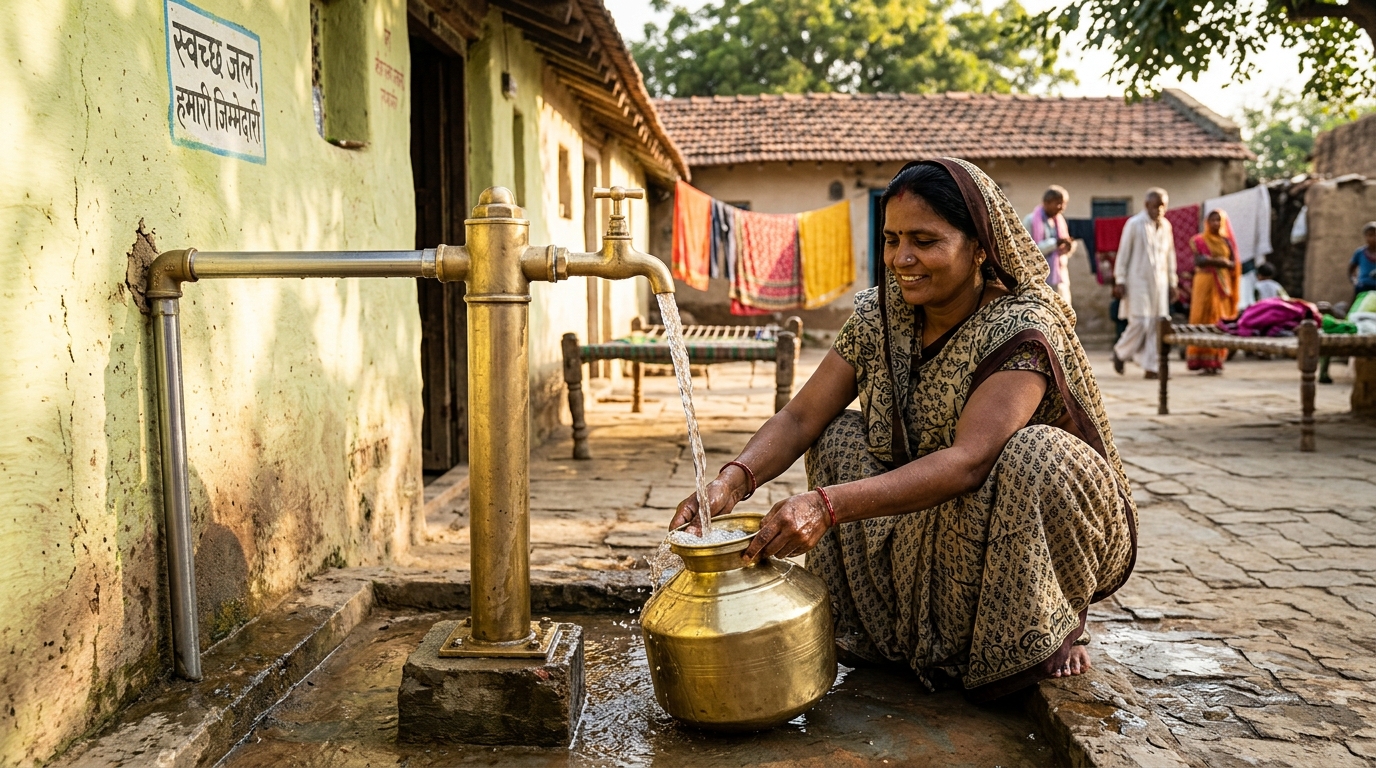
Over 120,000 automated telemetry stations report residual free chlorine, turbidity, and TDS directly from village distribution loops to state public health engineering dashboards.
In brief
On October 1, 2026, the National Jal Jeevan Mission under the Department of Drinking Water and Sanitation announced that real-time IoT multi-parameter water quality monitoring has expanded to 92% of all targeted rural multi-village piped water schemes across India. More than 120,000 solar-powered telemetry stations measure residual free chlorine, pH, and turbidity directly at village overhead reservoirs, automatically flagging pathogen contamination risks before water reaches domestic taps.
Providing piped tap water connections to every rural household under the Jal Jeevan Mission was a monumental civil engineering achievement. But ensuring that water flowing through millions of kilometers of rural pipelines remains microbially safe to drink 365 days a year is an even greater operational challenge.
The Challenge of Post-Treatment Microbial Regrowth
Water exiting a centralized water treatment plant is typically safe. However, as it travels through long rural pipeline networks with intermittent pumping cycles, negative pressure surges can pull external sewage and groundwater into pipe joints. Without sufficient residual disinfectant, waterborne pathogens (Vibrio cholerae, Salmonella, and rotaviruses) multiply rapidly inside the distribution pipes.
To solve this, the Jal Jeevan Mission deployed over 120,000 solar-powered IoT sensor stations at village overhead tanks and tail-end household clusters. The stations measure residual free chlorine (mandated at 0.2 to 0.5 mg/L), turbidity, and total dissolved solids (TDS), streaming readings every 15 minutes to state public health engineering command centers.
Automated Early Warning and Valve Interlocking
If residual chlorine drops below 0.2 mg/L or turbidity spikes above 5 NTU, the system automatically triggers SMS alerts to the local village water and sanitation committee (VWSC) and can activate motorized dosing pumps or shut distribution valves to prevent contaminated water from reaching home taps.
Districts with 100% active IoT chlorine telemetry reported a 62% decline in seasonal waterborne diarrheal outbreaks compared to historical five-year baselines.
The integration of digital IoT telemetry with grassroots public health infrastructure establishes India's Jal Jeevan Mission as a global benchmark in digital water governance.
Why it matters
Transforms rural public health delivery from passive, delayed manual sampling into an automated, proactive national surveillance shield against waterborne disease epidemics.
Sources
Ministry of Jal Shakti National Jal Jeevan Mission Dashboard (October 1, 2026)Read original ↗Jal Jeevan Mission National Portal and Dashboard↗Rispri Labs Rural Drinking Water Testing & IoT Sensor Skids↗Found an error? See the Corrections Policy.
Image: Piped Rural Drinking Water Infrastructure & Community Tap Standpost