
Hydrogeological field trials along the Coromandel coast prove injecting tertiary-treated surface run-off creates an artificial freshwater hydraulic ridge, protecting inland agricultural wells.
In brief
On October 6, 2026, the Central Ground Water Board (CGWB) in collaboration with the National Institute of Hydrology published the results of a multi-year Managed Aquifer Recharge (MAR) pilot project along the Coromandel coastal belt near Puducherry and Cuddalore. By injecting tertiary-filtered monsoon run-off into confined sandstone aquifers through pressurized dual-zone injection wells, the project successfully established an artificial freshwater pressure ridge that pushed saline seawater wedges back by 1.2 kilometers.
In coastal regions worldwide, groundwater over-extraction carries a catastrophic and often irreversible penalty: saltwater intrusion. When heavy pumping lowers the freshwater hydraulic head beneath coastal plains, high-density ocean saltwater flows inland through permeable geological strata, ruining drinking water wells and sterilizing fertile agricultural topsoil.
The Ghyben-Herzberg Hydrodynamic Principle
Under the Ghyben-Herzberg hydrogeological relationship, for every single meter of freshwater head lost above sea level, the subterranean saltwater interface rises by approximately 40 meters. In industrial and agricultural belts along the Tamil Nadu and Andhra Pradesh coast, decades of unmetered borewell pumping pulled the ocean wedge more than 5 kilometers inland.
The pilot project reversed this salinization by capturing peak monsoon stream run-off, pre-filtering it through rapid gravity dual-media sand filters to eliminate suspended silt, and injecting it directly into deep confined sandstone aquifers at 120 meters depth under 2.5 bar hydraulic pressure.
Creating an Artificial Freshwater Hydraulic Barrier
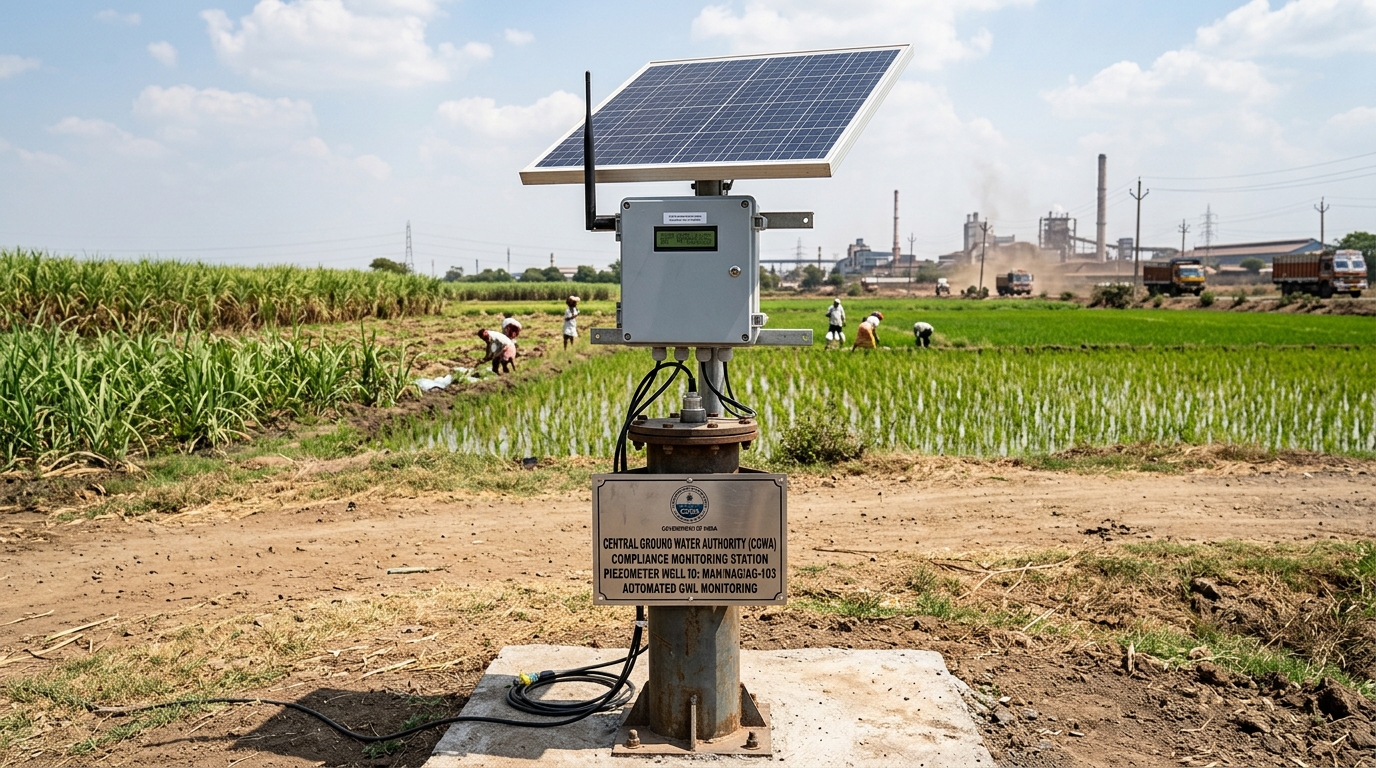
Continuous piezometric and electrical conductivity (EC) sensor monitoring showed that the injected freshwater formed a continuous subsurface hydraulic ridge. Groundwater salinity across 45 surrounding agricultural borewells plummeted from an undrinkable 4,200 µS/cm down to 780 µS/cm within two monsoon cycles.
Recharge water must undergo mandatory disinfection and turbidity reduction (NTU < 2) before injection to prevent irreversible bacterial bio-clogging of sub-surface aquifer pore spaces.
The CGWB announced plans to replicate dual-zone Managed Aquifer Recharge across vulnerable coastal industrial parks in Gujarat, Maharashtra, and Odisha over the next three years.
Why it matters
Provides a scalable engineering template for coastal industrial belts and agricultural regions worldwide facing irreversible aquifer salinization due to over-pumping.
Sources
Central Ground Water Board Technical Bulletin & Hydrological Case Archive (October 6, 2026)Read original ↗CGWB Managed Aquifer Recharge Master Plan↗Rispri Labs Hydrogeological Investigation & Borewell Testing↗Found an error? See the Corrections Policy.
Image: Automated Digital Piezometer & Real-Time IoT Groundwater Monitoring Station