
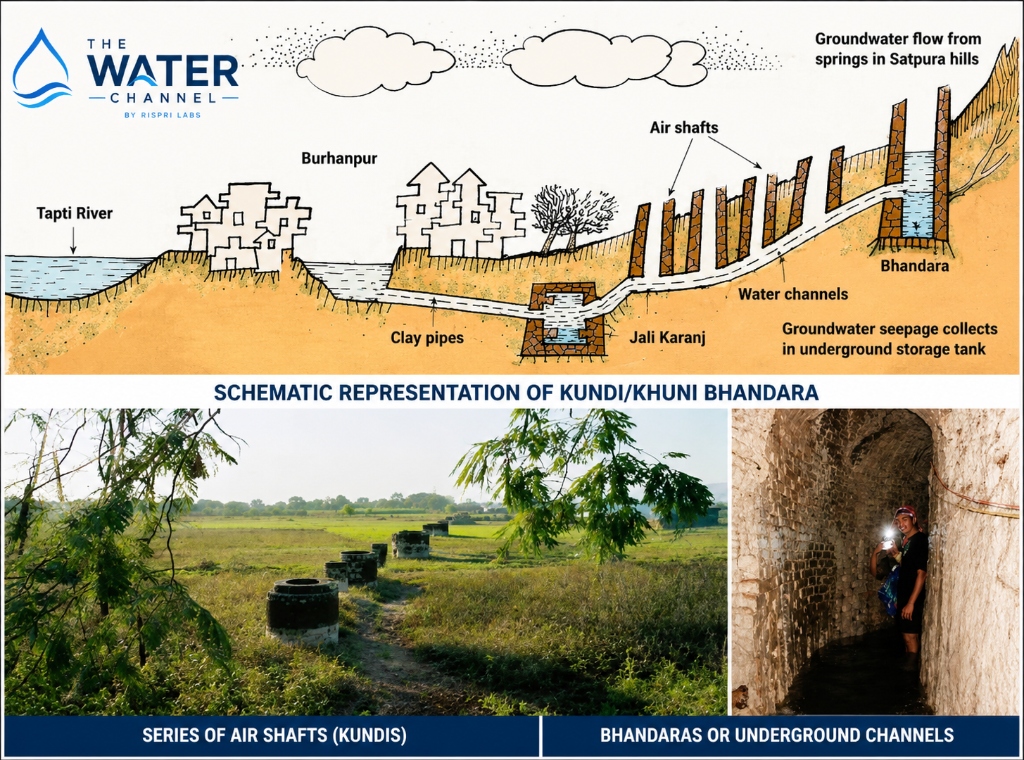
Ancient Mughal civil engineering in Burhanpur delivers millions of liters of clean water daily without pumps, electricity, or mechanical maintenance, offering crucial lessons for modern drought resilience.
In brief
On October 8, 2026, an interdisciplinary team of hydrogeologists and civil engineers released a detailed three-dimensional LIDAR and subterranean hydrological survey of the Khooni Bhandara aqueduct system in Burhanpur, Madhya Pradesh. Constructed in 1615 AD by Mughal engineer Tabqat-ul-Arz, the network of 107 vertical shafts and subterranean basalt galleries continues to intercept artesian springs, delivering millions of liters of pure gravity-pressurized potable water daily without consuming a single kilowatt of power.
While modern municipal water boards spend hundreds of crores annually on high-horsepower booster pumps and diesel generators to push water across hilly terrain, a 17th-century engineering marvel in Burhanpur, Madhya Pradesh, continues to run 24 hours a day with zero operational electricity.
The Engineering Genius of Tabqat-ul-Arz
Constructed in 1615 AD under the governorship of Abdul Rahim Khan-i-Khana, Khooni Bhandara ('the Crimson Reservoir') adapts the Persian qanat system to the complex volcanic basalt geology of Central India. Persian hydrogeologist Tabqat-ul-Arz surveyed the Satpura foothills, identifying fractured subterranean basalt strata that trapped natural artesian rainwater springs.
The system features 107 vertical circular air shafts sunk down into the rock, connected at the bottom by an arched masonry tunnel running 80 feet below the surface. By maintaining an exact downward slope of 1 meter per kilometer, the subterranean channel maintains laminar water flow: fast enough to prevent silt accumulation, yet gentle enough to avoid structural wall erosion.
Zero Evaporation and Natural Aquifer Filtration
Because the conduit operates entirely underground, water suffers zero evaporative losses during scorching 45°C Central Indian summers. Furthermore, water percolating through layers of volcanic gravel, quartz sand, and clay emerges naturally filtered, cool, and microbially pristine without chemical disinfection.
Modern urban planners frequently make the mistake of battling natural topography with oversized mechanical pumps. Designing localized water systems that follow hydrogeological fault lines and gravity gradients is inherently more sustainable and fault-tolerant.
As urban cities confront soaring electrical bills and frequent power-outage water supply collapses, Khooni Bhandara stands as a living testament to the enduring power of passive ecological civil engineering.
Why it matters
Demonstrates that harnessing natural geological gradients and sub-surface filtration provides centuries of climate resilience where modern energy-intensive pumping systems fail.
Sources
Indian Historical Hydrogeology Review & Geological Survey Field Study (October 8, 2026)Read original ↗Archaeological Survey of India Burhanpur Monuments Archive↗Rispri Labs Case Study on Khooni Bhandara Engineering↗Found an error? See the Corrections Policy.
Image: Mughal Subterranean Aqueduct & Khooni Bhandara Engineering Schematic