
Sub-micron gas bubbles exhibiting prolonged liquid residence times eliminate filamentous sludge bulking and dramatically enhance COD digestion in high-strength petrochemical wastewater.
In brief
Industrial pilot plant results published on October 15, 2026, demonstrate that micro-nanobubble (MNB) aeration generators boost Standard Oxygen Transfer Efficiency (SOTE) by 400% compared to fine-bubble diffusers. Generating millions of bubbles under 200 nanometers in diameter with neutral buoyancy, the technology sustains dissolved oxygen levels above 4.5 mg/L in heavily loaded petrochemical wastewater while curbing biological sludge production by 32%.
In biological wastewater treatment, maintaining adequate dissolved oxygen (DO) is the primary determinant of organic degradation rates and sludge settleability. However, in warm, high-salinity industrial effluents, traditional millimeter-scale air bubbles rise rapidly to the surface and burst, transferring less than 15% of their oxygen content to the liquid phase.
Hydrodynamic Cavitation and Neutral Buoyancy
Micro-nanobubble generators employ high-shear hydrodynamic cavitation to generate ultra-dense swarms of gas bubbles ranging between 50 and 200 nanometers in diameter. Possessing negligible buoyancy and high internal gas pressure (up to 30 atmospheres), these nanobubbles remain suspended in the water column for weeks, undergoing continuous spontaneous dissolution.
The persistent supersaturation of dissolved oxygen activates obligate aerobic heterotrophic bacteria while suppressing filamentous microbial strains that cause sludge bulking in secondary clarifiers. Furthermore, spontaneous nanobubble collapse generates localized hydroxyl free radicals that partially cleave complex recalcitrant ring compounds.
Elevated microbial metabolic efficiency stimulates endogenous respiration, reducing excess biological waste activated sludge (WAS) generation by 32%, lowering hazardous sludge dewatering and disposal costs.
Refinery and chemical ETPs across India and East Asia are integrating nanobubble side-stream loops to double biological capacity without building new aeration tanks.
Why it matters
Eliminates oxygen transfer limitations in overloaded biological wastewater plants, solving chronic filamentous bulking and dramatically reducing aeration blower electrical expenses.
Sources
Chemical Engineering Journal & Industrial Wastewater Review (October 15, 2026)Read original ↗Chemical Engineering Journal Nanobubble Dynamics Special Issue↗Rispri Labs Industrial ETP Aeration Optimization Services↗Found an error? See the Corrections Policy.
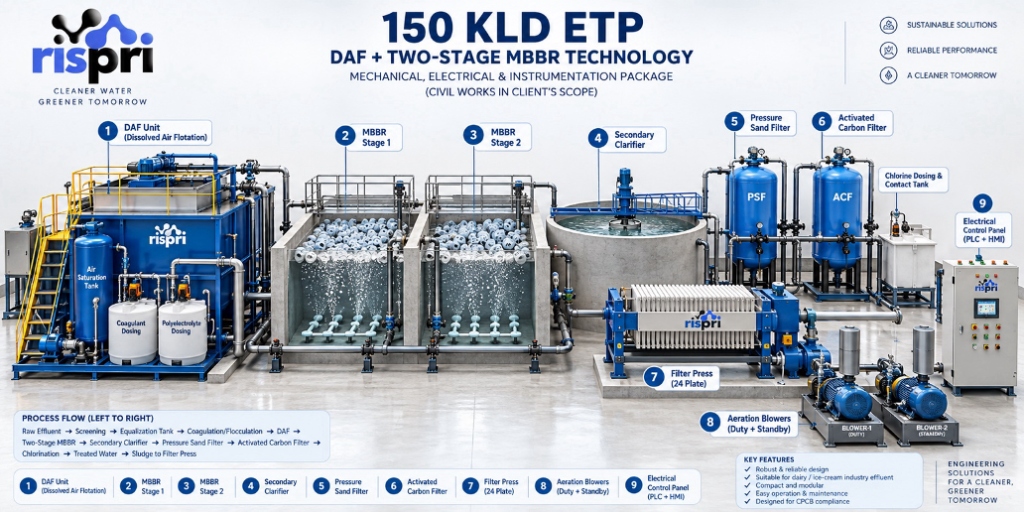
Image: Industrial Effluent Treatment Plant (ETP) Process Flow & DAF/MBBR Clarifier