
Continuous optical coherence tomography and machine learning sensor arrays predict silica and biofouling onset 72 hours early across utility-scale Gulf desalination plants.
In brief
On September 29, 2026, the Gulf Desalination Technology Consortium reported verified operational results from a full-year commercial deployment of predictive machine learning analytics across three utility-scale Seawater Reverse Osmosis (SWRO) mega-facilities in Saudi Arabia and the UAE. By pairing real-time optical coherence tomography (OCT) flow-channel sensors with deep learning algorithms, plant operators forecast biofouling and mineral scaling onset 72 hours in advance, reducing chemical Clean-in-Place (CIP) downtime by 40%.
In the Persian Gulf and Red Sea, seawater reverse osmosis (SWRO) facilities operate under some of the most punishing marine conditions on earth: extreme summer water temperatures exceeding 35°C, high salinity (TDS > 44,000 ppm), and frequent seasonal red-tide algal blooms that rapidly foul membrane surfaces.
The Cost of Reactive Clean-in-Place (CIP)
Historically, plant operators ran membranes until hydraulic feed pressure or differential pressure (delta-P) climbed by 15%—a standard industry rule of thumb. However, by the time bulk differential pressure spikes, biofouling layers and hard silica crystals have already compacted into feed spacer channels, requiring aggressive acid and caustic chemical cleaning that damages delicate polyamide membranes.
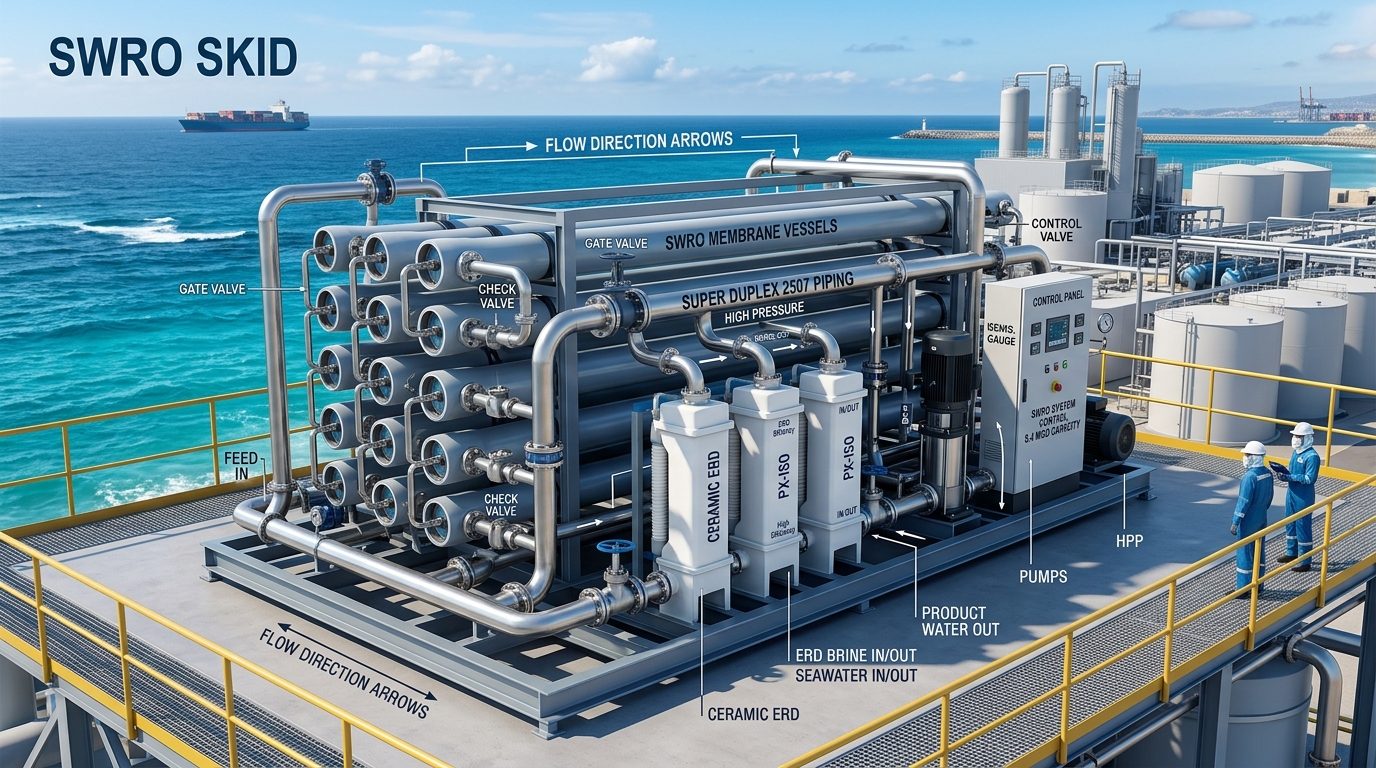
The AI-driven predictive system changes this reactive dynamic. Non-invasive optical coherence tomography (OCT) sensors mounted directly on lead and tail membrane pressure vessels provide real-time, cross-sectional imaging of biofilm growth at sub-micron resolution.
Proactive 72-Hour Early Warning
Machine learning neural networks analyze optical biofilm thickness alongside multi-variable telemetry (temperature, permeate flux, silt density index, and raw seawater conductivity) to forecast fouling onset 72 hours in advance. Operators can instantly modulate antiscalant dosing, adjust coagulant pre-treatment, or initiate gentle flushing before irreversible scaling sets in.
Over a full year of continuous commercial operations, membrane lifespan was extended by an estimated 2.5 years while hazardous chemical cleaning effluent volume dropped by 38%.
The successful integration of predictive machine learning in desalination proves that digital sensor intelligence is just as vital as physical membrane chemistry in ensuring global water security.
Why it matters
Significantly extends membrane lifespan and slashes chemical cleaning costs across the world's largest municipal desalination hubs.
Sources
International Desalination Association Conference & Middle East Water Report (September 29, 2026)Read original ↗IDA Seawater Reverse Osmosis Technical Committee Report↗Rispri Labs Membrane Plant Optimization & Chemical Testing↗Found an error? See the Corrections Policy.
Image: Seawater Reverse Osmosis (SWRO) Membrane Vessels & Isobaric Energy Recovery