
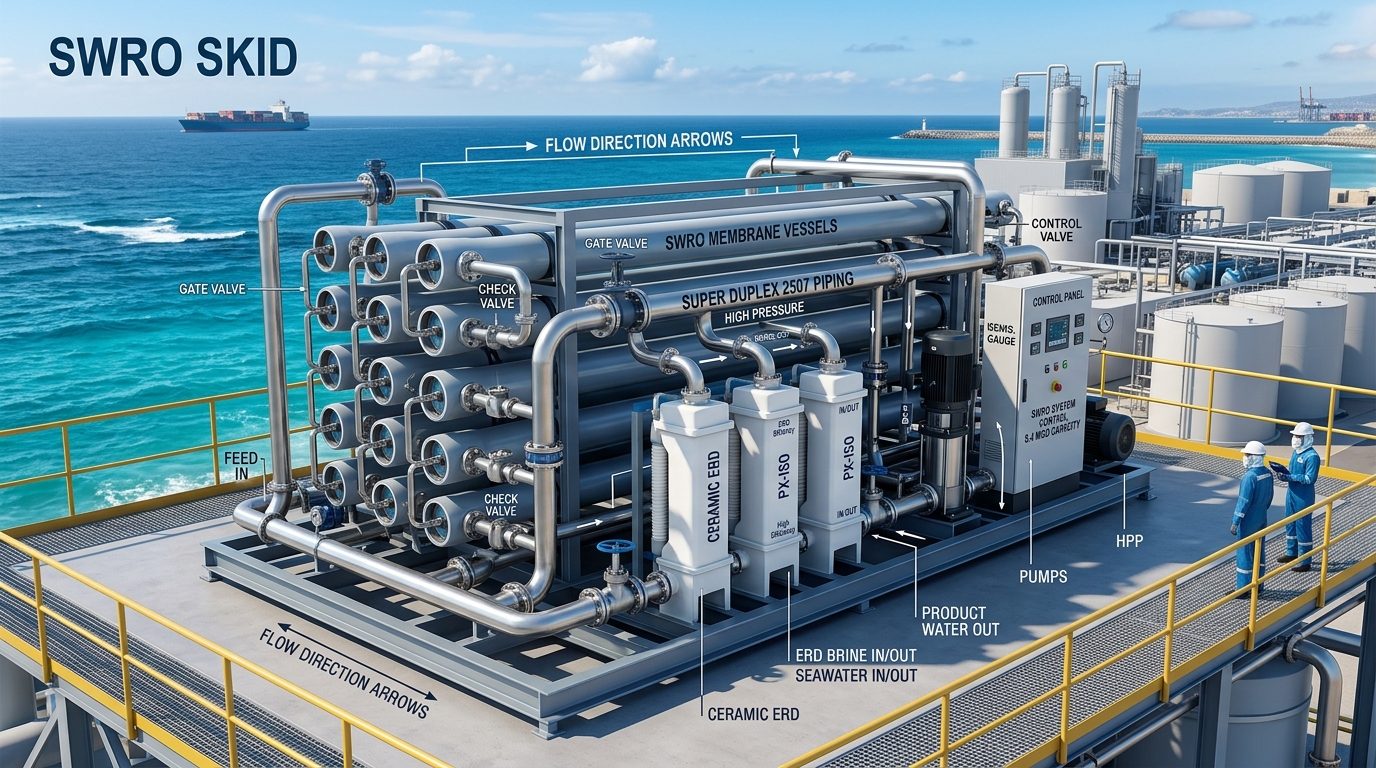
High-efficiency isobaric energy recovery devices coupled with next-generation low-fouling polyamide membranes reduce desalination operational power demand to record lows.
In brief
Commercial operational performance audits announced on October 10, 2026, across newly commissioned mega-scale Seawater Reverse Osmosis (SWRO) facilities in the Gulf region confirm that plant-wide specific energy consumption has fallen to 2.45 kWh/m³. The milestone was achieved through high-efficiency isobaric energy recovery devices (ERDs), advanced variable-frequency high-pressure pumps, and high-flux polyamide membrane chemistry.
Seawater desalination has long been constrained by its heavy energy footprint. In the 1990s, thermal distillation plants consumed over 12 kWh of equivalent thermal energy per cubic meter of freshwater, while early reverse osmosis plants required 6 to 8 kWh/m³. The latest audited metrics demonstrate that SWRO has entered an era of unprecedented thermodynamic efficiency.
Isobaric Pressure Exchangers and High-Flux Elements
The audited 100+ MIGD plants integrate ceramic rotary isobaric pressure exchangers that transfer hydraulic energy from the concentrated 70-bar reject brine directly to the incoming seawater feed stream with greater than 98% mechanical efficiency. High-pressure pumps are required to handle only the net permeate fraction.
Simultaneously, high-flux polyamide membrane elements featuring tailored cross-linking densities provide superior salt rejection (>99.8%) at lower operating hydraulic pressures, maintaining low biological and organic fouling rates in warm Gulf waters.
When coupled with dedicated utility-scale solar photovoltaic arrays, modern SWRO plants produce freshwater at a levelized carbon intensity of less than 0.4 kg CO2 per cubic meter.
Global desalination planners note that low operating power enables water-stressed coastal nations across North Africa and the Mediterranean to expand desalination without overwhelming electrical grids.
Why it matters
Dramatically reduces the operating cost and carbon footprint of seawater desalination, making desalinated water increasingly affordable for coastal municipal utilities globally.
Sources
International Desalination and Reuse Association (IDRA) Technical Review (October 10, 2026)Read original ↗IDRA Global Desalination Energy Efficiency Benchmark Database↗Rispri Labs Industrial Desalination & High-Recovery RO Services↗Found an error? See the Corrections Policy.
Image: Seawater Reverse Osmosis (SWRO) Membrane Vessels & Isobaric Energy Recovery