
The Environment Ministry bans open drain transit to Common Effluent Treatment Plants and strictly prohibits using treated CETP effluent for agricultural crop irrigation.
In brief
The Ministry of Environment, Forest and Climate Change (MoEFCC) has notified sweeping amendments to the Common Effluent Treatment Plant (CETP) framework. Industrial units sending wastewater to CETPs must route flow exclusively through sealed, underground closed-pipeline systems - eliminating open storm-drain conveyance. Simultaneously, applying treated CETP effluent to food crop agriculture has been prohibited nationwide.
In a major structural shift for industrial pollution control, India's Ministry of Environment, Forest and Climate Change (MoEFCC) has officially amended the regulatory framework governing Common Effluent Treatment Plants (CETPs). The new notification establishes two non-negotiable mandates: all industrial wastewater traveling from manufacturing units to CETPs must flow through dedicated, closed-pipeline conduit systems, and treated CETP effluent is strictly banned from agricultural crop irrigation.
Sealed Pipeline Infrastructure & Eliminating Open Drain Leaks
Historically, many industrial clusters relied on open masonry drains or storm channels to convey partially treated trade effluent to regional CETPs. Under the 2026 framework, open drain conveyance is illegal. Industrial estates in Gujarat, Maharashtra, Tamil Nadu and Haryana must transition to underground pressurized closed piping equipped with tamper-proof electromagnetic flowmeters at every factory discharge gate.
The simultaneous ban on agricultural discharge addresses soil heavy-metal accumulation and food safety risks. CETPs must now upgrade to tertiary Reverse Osmosis (RO) and Zero Liquid Discharge (ZLD) systems to supply recycled process water back to industrial manufacturing loops rather than releasing it onto farmland.
Why it matters
Factories can no longer discharge into open surface drains leading to regional CETPs. Industrial clusters must build or upgrade to pressurized closed conduit networks, while CETPs must achieve tertiary RO/ZLD standards for industrial reuse rather than farm disposal.
Sources
MoEFCC Gazette Notification & CPCB CETP Regulatory Framework 2026Read original ↗CPCB Official Effluent Portal↗Rispri Labs Industrial ETP & CETP Solutions↗Found an error? See the Corrections Policy.
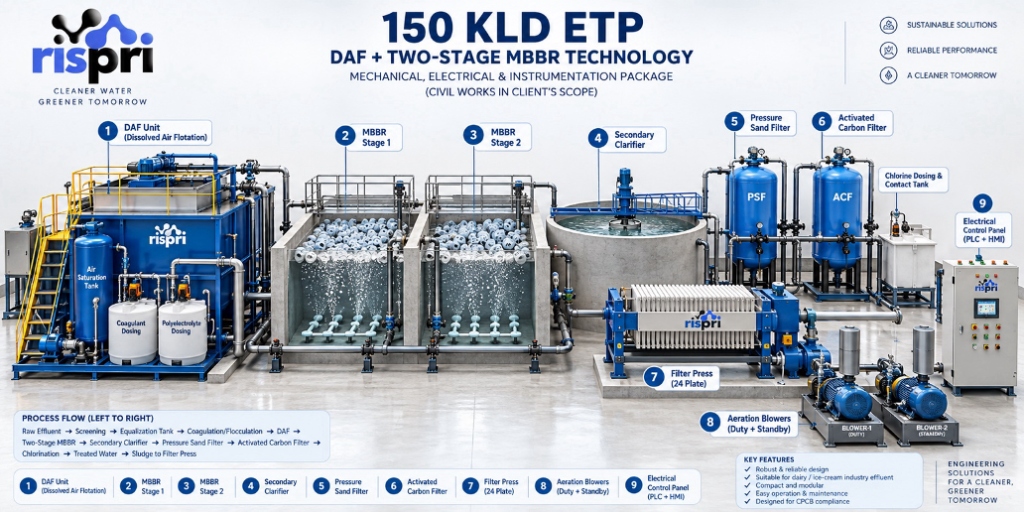
Image: Industrial Effluent Treatment Plant (ETP) Process Flow & DAF/MBBR Clarifier