
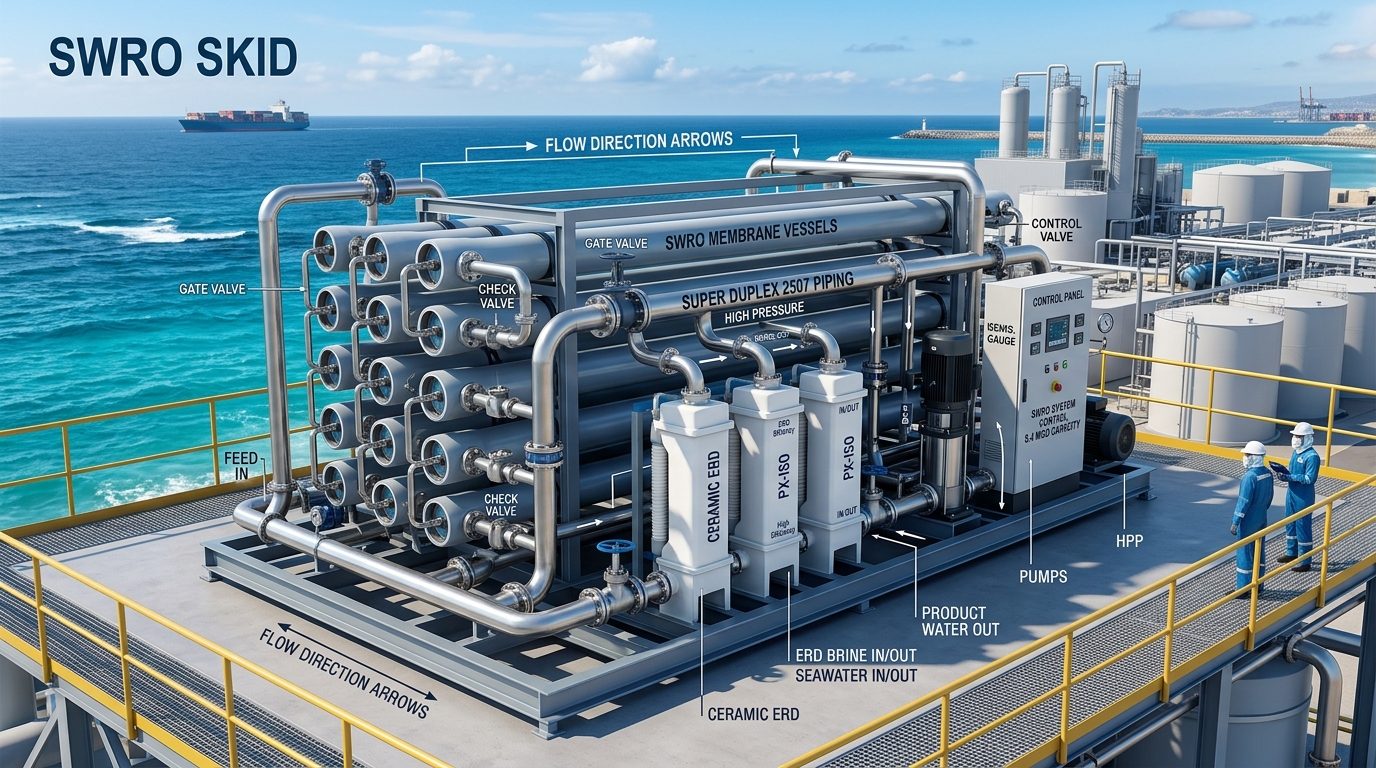
Next-generation energy recovery devices and high-permeability thin-film nanocomposite (TFN) membranes drive municipal seawater desalination power usage to historic lows.
In brief
On October 2, 2026, performance auditing data verified by the International Desalination Association (IDA) confirmed that a utility-scale 250,000 m³/day Seawater Reverse Osmosis (SWRO) facility has broken the historic energy efficiency threshold: operating at a specific energy consumption of 2.648 kWh per cubic meter (1,000 liters) of produced potable water.
For four decades, the primary critique of seawater desalination was its immense electrical appetite. In the 1980s, thermal distillation plants consumed 12 to 16 kWh/m³. Early reverse osmosis plants in the 1990s required 6 to 8 kWh/m³. But ongoing innovations in materials science and fluid mechanics have rewritten the economics of drinking water.
The Engineering Behind 2.65 kWh/m³
Achieving this unprecedented benchmark required a synergistic pairing of two technologies: First, Thin-Film Nanocomposite (TFN) polyamide membranes embedded with hydrophilic metal-organic frameworks (MOFs) that deliver 25% higher water flux per bar of pressure while maintaining 99.85% sodium chloride rejection.
Second, positive-displacement ceramic isobaric pressure exchangers. In reverse osmosis, 55% of pressurized seawater exits as high-pressure reject brine (65 bar). Ceramic pressure exchangers capture that hydraulic pressure and transfer it directly to incoming raw seawater with net energy transfer efficiency exceeding 98%.
Cheaper Than Pumping Water Across Mountains
To understand the economic power of 2.65 kWh/m³, consider this: pumping water 200 kilometers through cross-country canal pipelines and over mountain ridges often requires between 3.0 and 4.5 kWh/m³ in booster electricity alone. Desalinating local seawater right on the coastline has officially become less energy-intensive than transporting distant river water.
When paired with dedicated solar utility power generating electricity at ₹2.30/kWh, the electrical energy cost to produce 1,000 liters of pure drinking water from the ocean is under ₹6.20.
As coastal populations expand, breaking the 2.65 kWh threshold proves that technological engineering can decouple human prosperity from freshwater scarcity.
Why it matters
Removes the historical cost barrier of seawater desalination, making ocean water treatment cheaper and more energy-efficient than long-distance inter-basin river pumping.
Sources
International Desalination Association Benchmarking Bureau (October 2, 2026)Read original ↗Global Water Intelligence Desalination Performance Index↗Rispri Labs Seawater & Industrial RO Plant Design Services↗Found an error? See the Corrections Policy.
Image: Seawater Reverse Osmosis (SWRO) Membrane Vessels & Isobaric Energy Recovery